
- Chennai
- Tamil Nadu
- India
- World
- EntertainmentEntertainment
- Business
- Sports
- Lifestyle
- Technology
- Videos
- Explainers
- Editor's Picks
GALCCHI: Body number 1003 at a state-run hospital in Nepal’s Pokhara was claimed by three families, each believing they had found a missing relative after the devastating floods.
The families of Gopal Dahit, a hydropower worker from Bardiya, and Damodar Basyal, a tourist guide from Rupandehi, were among its latest claimants. Another family had initially claimed it on Sunday.
Dahit and Basyal were still disputing the identity of the body, Nepal News reported on Monday. The third family seemed to have stepped back.
The case reflects the difficulties facing families and authorities as bodies recovered far downstream are brought to hospitals, where photographs, physical features and personal belongings are often being used to establish identities.
The August 26 flood left hundreds dead in Nepal. Body number 1003 lying in the Pokhara Academy of Health Sciences is one of them. It now has to undergo DNA testing.
At Pokhara, relatives have been gathering at the hospital to examine photographs of unidentified bodies, scrutinising facial features, body structure, teeth, ears, lips and other distinctive marks, Nepal News reported.
The Kathmandu Post reported Monday that 102 bodies recovered from Gorkha, Tanahun, Dhading and Nawalparasi East districts had been brought to Pokhara -- a town located around 280 km from capital Kathmandu.
By Monday, 16 had been identified and handed over to relatives, while 87 had undergone postmortem examinations. Police had collected DNA samples from relatives of five families because of disputed identification claims.
For the Dahit family, the search began after Gopal, who had gone to Rasuwa to work at a hydropower project, went missing in the flood.
His sister Manji Tharu and other relatives travelled from Bardiya to Gaindakot, where they were shown photographs of recovered bodies and identified body number 1003 as Gopal, according to The Kathmandu Post.
They travelled to Pokhara hoping to take him home. But before the family could collect the body, Basyal's relatives also appeared and claimed it.
Basyal's family said several physical features matched their missing relative, while Dahit's family said the body's teeth, forehead, lips, hands, chest and face matched Gopal's features, the newspaper reported.
Both families reportedly agreed that DNA testing was needed to settle the dispute.
Nepal News reported that police had already collected DNA from the recovered bodies, but matching the samples could take one to one-and-a-half months because of the volume of testing being handled by the Nepal Police Laboratory and the Nepal Academy of Science and Technology laboratory.
In another case, a family identified a five-year-old boy through the belongings he was wearing.
The Kathmandu Post reported Sunday that Raj Kumar Tamang of Bidur in Nuwakot district, identified the body of his son Prince from a school tie, necklace and earring after seeing photographs of recovered bodies published on the Nepal Police website.
Prince had gone to school in his uniform before disappearing when the Trishuli flooded. His body was recovered from the Narayani River in Nawalparasi district, far downstream from the flood-hit area.
The tie bore the name of Uttargaya Secondary School in Bidur, where Prince was a lower kindergarten student, the newspaper reported.
Satya Krishna Prajapati of Bhaktapur identified the body of his elder brother, Satya Sundar Prajapati, from a tattoo on his shoulder, according to The Kathmandu Post.
Satya Sundar had been working as a site engineer at the under-construction Upper Trishuli-1 hydropower project in Rasuwa. His remains were taken back to Kathmandu on Friday, the Post reported.
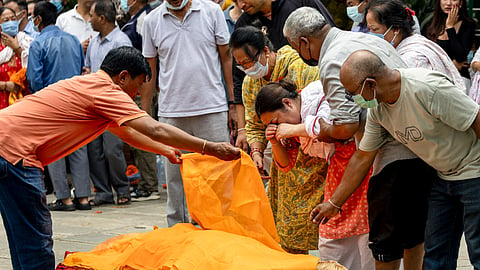
Hospitals across Nepal have been witnessing crowds of people looking for their missing relatives. The focus is increasingly shifting towards identifying the dead. Photographs have been pasted outside hospital walls, where large gatherings could be seen scanning them.
Only a few dozen of the hundreds of bodies recovered were identified till Monday, with authorities saying many remains are badly decomposed, mutilated or otherwise difficult to recognise after prolonged exposure to floodwaters.
At Tribhuvan University Teaching Hospital in Kathmandu, The Rising Nepal reported Monday that 94 bodies had been brought in, of which only nine had been identified and handed over to families.
In Chitwan district, 272 bodies were recovered but, Radio Nepal reported Monday, only 12 of them had been identified. Authorities had buried 199 unidentified bodies after preserving DNA samples and other identifying information.
For families searching for missing relatives, the process can therefore depend on a photograph, a piece of jewellery, a tattoo or another small distinguishing feature. But where those clues are inconclusive, they must wait for forensic evidence.
