
- Chennai
- Tamil Nadu
- India
- World
- EntertainmentEntertainment
- Business
- Sports
- Lifestyle
- Technology
- Videos
- Explainers
- Editor's Picks
KATHMANDU: Security personnel risking their lives to rescue survivors and recover bodies after the devastating flash floods in Nepal are facing major challenges due to shortages of specialised rescue equipment, body bags, ropes and helicopters, officials said.
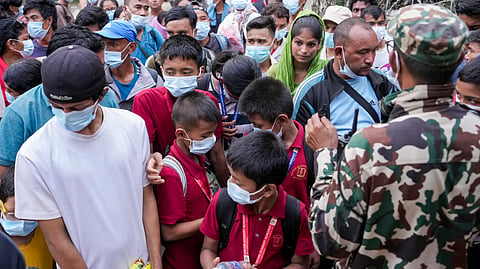
The flash floods, believed to have been triggered by a collapse or avalanche of ice and rock near the Nepal-Tibet border on August 26, swept through the Bhotekoshi River corridor, destroying homes, roads and bridges and damaging hydropower projects.
The death toll from the disaster crossed 900 on Monday, while over 4,000 people remained missing, according to the National Disaster Risk Reduction and Management Authority (NDRRMA).
Personnel from the Nepal Army, Nepal Police and Armed Police Force have been deployed in large numbers in the affected areas, but officials said the lack of state-of-the-art equipment was making operations in dangerous terrain particularly difficult, news portal ekantipur.com reported on Monday.

Among the equipment in short supply are thermal cameras, devices capable of detecting signs of life through sound, specialised tools for cutting through obstacles, body bags, ropes and advanced helicopters, the report said, quoting officials.
Security personnel have also repeatedly sought helicopters to reach people trapped or stranded in difficult-to-access areas.
A police inspector said several people had contacted Police Control 100 seeking assistance, but personnel were sometimes unable to reach them because of operational difficulties.
The Nepal Police, considered the frontline agency in responding to emergencies, has repeatedly sought the purchase of helicopters, officials said.
Police personnel deployed in Bidur also reported shortages of equipment used to cut trees and other objects during rescue operations.
"There is also a shortage of bags to store the bodies," a police officer said, adding, "Even ropes are not enough."
Anil Pokharel, former chief executive officer of the National Disaster Risk Reduction and Management Authority (NDRRMA), said the shortage of specialised equipment was a longstanding problem.
"It would be easier if there were equipment, but even when I was at the authority, there was a shortage in the international market when I tried to purchase those equipment," he said.
"However, if the goods can be brought even at such a time, it will be easier for tomorrow," Pokharel said, while praising the efforts of security personnel involved in the ongoing operations.
"Security personnel have been mobilised now, just like during the earthquake," he said.
According to the NDRRMA, 19,895 security personnel have been mobilised for rescue operations, including 7,293 from the Nepal Police, 8,399 from the Nepal Army and 4,203 from the Armed Police Force.
The Armed Police Force has also deployed trained sniffer dogs to assist in the search for victims.
"Based on the dog's signals, 5-7 bodies are being found daily," an Armed Police Force officer said.
Separate teams have been mobilised for mass rescue, medical assistance, management of affected people at holding centres, rope rescue, water rescue, diving, canine searches, drone operations and search and rescue at collapsed structures, the officer said.
A joint search operation by the Nepal Army, Armed Police Force and Nepal Police is continuing in the affected area. An 84-member team, comprising 62 Army personnel and 22 personnel from the Nepal Police and Armed Police Force, has been deployed for rescue operations, according to officials.
A total of 4,811 Nepal Police personnel have also been mobilised for rescue and the search for bodies, officials said.
The Nepal government has sought specialised personnel and equipment from India and China to strengthen search and rescue operations following the floods, The Himalayan Times newspaper reported.
India has deployed specialised teams to assist Nepal in rescue operations and the identification of victims.
A 19-member Indian forensics team began functioning in Kathmandu on Sunday to augment the analysis of DNA samples for identifying mortal remains, while an Indian tunnel rescue team continued its operations at hydropower sites in Chilime and Langtang, it said.
Expert teams from India and China are assisting Nepal's rescue teams in trying to trace over 930 workers and employees in various hydropower project sites who have been out of contact since August 26, with many believed to be trapped in tunnels, the NDRRMA said.
The equipment shortage has also highlighted concerns about Nepal's disaster-management capacity.
A year ago, the NDRRMA had only one expert on its staff. Geologist Gangalal Tuladhar, who had served as an expert, completed his tenure a year ago.
"For the past year, the authority has not had a single expert," Sushil Kumar Shrestha, senior divisional engineer at the authority, was quoted as saying by MyRepublica news portal.
The NDRRMA has been allocated Rs 200 million for the current fiscal year, but officials said the amount was inadequate to meet its requirements.
"The budget is insufficient. It is largely spent on staff salaries and routine programmes," Shrestha said.