
- Chennai
- Tamil Nadu
- India
- World
- EntertainmentEntertainment
- Business
- Sports
- Lifestyle
- Technology
- Videos
- Explainers
- Editor's Picks
LONDON: Several international airlines resumed limited flights from the United Arab Emirates on Monday, offering some relief for travellers caught up in airspace closures and other safety precautions as the US and Israel bombarded Iran, and Iran struck back at targets across the Middle East.
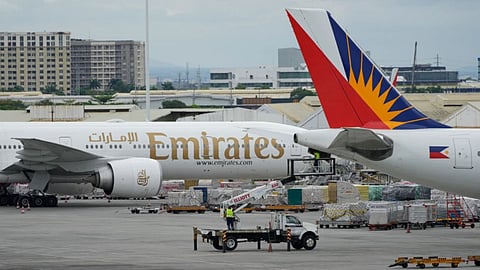
Long-haul carriers Etihad Airways and Emirates, based in Abu Dhabi and Dubai, and budget carrier FlyDubai, said they would operate select flights from the country, where air traffic was suspended Saturday and defence systems have intercepted Iranian missiles and drones.
Dubai's government told passengers to head to airports only if they were contacted directly during what it said would be a “limited resumption of operations”.
At least 15 Etihad flights took off from Abu Dhabi's airport Monday to help evacuate passengers who have been stranded there, according to tracking service Flightradar24. The flights headed to a variety of destinations, including Islamabad, Paris, Amsterdam, Mumbai, Cairo and London. But regular commercial flights remained canceled.
Emirates said it would also fly limited flights beginning Monday evening, but it wasn't immediately clear if those had begun. It previously said it was suspend flights until 3 pm local time Tuesday.
“We are accommodating customers with earlier bookings as a priority,” it said.
FlyDubai said it would also operate a limited number of flights on Monday evening, including four flights departing the city and five more arriving flights.
“We continue to work closely with the relevant authorities and stakeholders to ensure an efficient, gradual return to operations,” it said in an emailed statement. “The situation remains dynamic, and we continue to monitor closely and amend our schedule accordingly.”
With air travel mostly halted throughout the Middle East, the conflict that started Saturday stranded travellers in multiple countries besides Iran and Israel. Tourists, business travellers and religious pilgrims found themselves stuck unexpectedly in hotels, airports and on cruise ships.
The airports in Dubai, Abu Dhabi and Doha, Qatar, which are important hubs for travel between Europe, Africa and the West to Asia, were all directly hit by Iranian strikes over the weekend.
Along with people planning to head to or from the region, travellers who were passing through airports for long-distance flights also found themselves stuck.
Indian technology entrepreneur Varun Krishnan was aboard a Qatar Airways flight on Saturday headed to Barcelona for a conference when it was forced to turn around. Now he's one of the many travellers stuck in Doha.
The airline put him up in an hotel and was providing meals, but Krishnan said he was reconsidering his plans to attend the Mobile World Congress, a major telecom industry trade fair.
“At this point in time, I don't think I'm in any mental kind of situation to go work from there,” he said. “I think I'll probably take the flight back home, given an option. I don't think going to Barcelona or MWC is on my mind anymore, given what we have gone through in the last two, three days here.”
Doha-based Qatar Airways said its flights remained suspended, with its next update planned for Tuesday morning. Jordan announced a partial closure of its airspace Monday, stretching the travel turmoil in the region.
Governments told stranded citizens to shelter in place while officials scrambled to find ways to get them home.
More than 58,000 Indonesians were stranded in Saudi Arabia, where they were visiting Islam's holy sites of Mecca and Medina on an Umrah pilgrimage during Ramadan.
“It has become an urgent humanitarian and logistical issue,” said Ichsan Marsha, spokesperson for Indonesia's Ministry of Hajj and Umrah, which was coordinating with Saudi authorities, airlines and Indonesian travel operators to arrange alternative routes or rescheduled flights.
Thousands of travellers also were stranded on Indonesia's tourist island of Bali because of international flight cancellations.
About 30,000 German tourists are currently stranded on cruise ships, in hotels or at closed airports in the Middle East and cannot get back home because of the conflict.
German Foreign Minister Johann Wadephul said late Sunday a military evacuation wasn't possible because of airspace closures and that the government was looking into other options to help bring citizens home. He said everyone should follow advice from German travel agencies and local authorities.
The German Travel Association called on tourists to “remain at their booked hotels as a matter of urgency” and not “make their own way to the airport or to a neighbouring country.”
Other governments made similar recommendations.
The Czech Republic said it was sending two planes to Egypt and Jordan to bring home Czech nationals, Prime Minister Andrej Babiš said. One will pick up 79 Czechs in the Egyptian resort town of Sharm El Sheikh who want to return from Israel.
They are travelling from Israel to Egypt by bus. The other plane will evacuate Czechs from Amman, Jordan. Babiš said there are some 6,700 Czechs in the region.
Four more planes were heading to Muscat and Salalah in Oman to fly home Czech tourists.
Britain was preparing for all options, including possible evacuation of Britons in the Middle East, Foreign Secretary Yvette Cooper said.
“We are setting up the support systems,” Cooper told Sky News, when asked if Britain was preparing for an evacuation. “We're working on every possible option.”
More than 102,00 Britons in the region have registered their presence with the UK government since the conflict erupted on the weekend.
US airlines issued travel advisories and upended global transportation roiled the travel sector in financial markets early Monday, including the shares of airlines that fly globally.
United, Delta and American all slid 5% to 6% and global hotel chains tumbled. Cruise lines like Carnival fell even harder.
The Gulf's shimmering and globalised cities depend on a steady influx of flights carrying foreigners – both tourists and resident workers – and cargo to keep their economies humming.
That's fuelled the growth of Gulf airline brands including Emirates, Qatar Airways and Etihad Airways.
Those long-haul airlines and a handful of smaller carriers typically pack the skies over the Gulf and have turned their hubs into some of the busiest international airports in the world.
Dubai International Airport handled a record 95.2 million passengers last year, ensuring its status as the world's busiest airport when measured by international travel. It's second only to Hartsfield-Jackson Atlanta International Airport overall.
