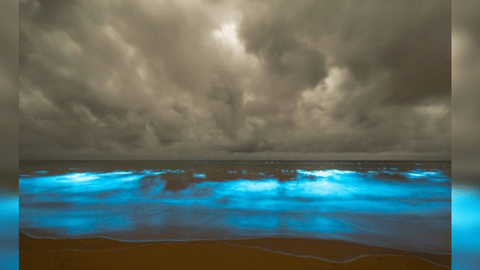

MELBOURNE: Scientists say a bioluminescent bloom lighting up the southeast coastline of Australia's island state of Tasmania, with red tides by day and blue glows by night, stems from climate-driven ocean warming, not pollution from nearby salmon farms.
The glow, reappearing almost a year after a similar event, is caused by Noctiluca scintillans, a bioluminescent marine plankton that feeds on microscopic algae and rises to the surface when it dies, creating red slicks that illuminate when disturbed, the Australian Broadcasting Corporation reported on Tuesday.
Authorities have advised against swimming in affected areas, though the spectacle continues to draw crowds to \ reports Xinhua news agency.
Marine biologist Lisa-ann Gershwin said while breathtaking, the bloom can emit ammonia, which can cause skin irritation for humans and deplete the oxygen in nearby waters, resulting in the deaths of some marine animals.
Gershwin described the phenomenon as a sign of ecological imbalance influenced by warmer waters from the strengthening East Australian current, caused by climate change.
Emeritus Professor Gustaaf Hallegraeff from the University of Tasmania said the bloom was driven by natural nutrients from the deep sea, rather than from "land runoff or salmon farms."
This organism "has no need for" nutrients like ammonia and urea released by salmon farms, said Hallegraeff, who has researched harmful algal blooms for more than 40 years.
However, it can cause problems for the salmon farm. A Noctiluca slick off Tasmania's Tasman Peninsula deterred salmon from surfacing to feed in 2003, experts said.
Gershwin warned that conditions favouring Noctiluca could enable similar harmful blooms like the widespread toxic algal outbreaks caused by the Karenia cristata organism in South Australia.
However, Noctiluca scintillans blooms pose minimal risk, Hallegraeff said, noting no evidence yet of Noctiluca's climate-expanded range disrupting other organisms.