
- Chennai
- Tamil Nadu
- India
- World
- EntertainmentEntertainment
- Business
- Sports
- Lifestyle
- Technology
- Videos
- Explainers
- Editor's Picks
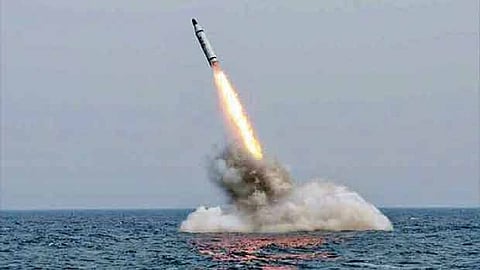
BEIJING: China on Monday successfully test-fired a long-range strategic missile from one of its nuclear-powered submarines in the Pacific Ocean, drawing sharp reactions from Japan and Australia.
The Chinese People's Liberation Army (PLA) Navy said that one of its nuclear submarines successfully launched a strategic missile carrying a dummy warhead toward the relevant high seas of the Pacific Ocean at 12:01 pm, state-run Xinhua news agency reported.
The missile landed precisely within the designated waters, the report said.
The test launch is a routine arrangement of the annual training of the PLA Navy, the Navy said, adding that the Chinese side has already notified relevant countries in advance.
The test launch complies with international law and international practice, and is not directed at any specific country or target, the Navy said, without identifying the missile and its range.
Japan and Australia, which confirmed they had been given advance notice of the launch, criticised China for the test, saying that it reflected China's heavy military build-up in the region.
Australian Foreign Minister Penny Wong said the launch was "destabilising to the region."
“Australia has been clear that this proposed test is in the context of a rapid military build-up by China, which is lacking in the transparency and reassurance as to intent that the region expects,” she was quoted as saying by the Hong Kong-based South China Morning Post.
"Destabilising acts can lead to miscalculation, can lead where we do not want these actions to lead. I think China is aware of Australia's position," Senator Wong was quoted as saying by the Australian Broadcasting Corporation.
"The Pacific Island Forum leaders have made clear they want the Pacific to be an ocean of peace. We regard this proposed test as counter to that."
Japan's Kyodo News said Japan has expressed “serious concern” about China’s military activities, saying it had asked Beijing to “rethink” the missile test when Tokyo was informed to ensure it would not threaten Japan’s security.
In Beijing, the Chinese Foreign Ministry played down the significance of the test, saying that “this is a routine arrangement for China’s annual military training, consistent with international law and international practice, and not targeted at any specific country or target."
The launch activity was conducted in a safe, standardised and professional manner throughout.
"We hope relevant countries will not overinterpret it," said Chinese Foreign Ministry spokesperson Mao Ning.
About the details of the missile, she said China has released information on that. "For more details, I would refer you to the competent department,” Mao added.
It is unclear which type of submarine launched the missile. China's main battle nuclear submarine is known as Type 094. Beijing operates at least six nuclear submarines, which are considered ideal for deployment near the disputed South China Sea.
China claims most of the South China Sea. The Philippines, Vietnam, Malaysia, Brunei and Taiwan have counterclaims.
China’s submarines are capable of firing JL-2 missiles, and possibly the more sophisticated JL-3, which can strike US territory from Chinese shores, the Hong Kong-based South China Morning Post reported.
China’s more advanced nuclear submarine, the Type 095, was spotted earlier this year.
In recent years, the Chinese Navy has emerged as the world's largest, operating 234 warships compared to the US Navy's 219 building ships.
Between 2019 and 2023, China's four largest shipyards - Dalian, Guangzhou, Jiangnan and Hudong-Zhonghua - produced 39 warships with a combined displacement of 550,000 tonnes, according to a study by the Centre for Strategic and International Studies (CSIS).
The Chinese Navy has added 11 combat vessels, including the third aircraft carrier, Fujian, in 2025. China is building a fourth aircraft carrier, which reports say was expected to be a nuclear-powered vessel.
