
- Chennai
- Tamil Nadu
- India
- World
- EntertainmentEntertainment
- Business
- Sports
- Lifestyle
- Technology
- Videos
- Explainers
- Editor's Picks

MADURAI: In an era of global warming, life in the mountains is no longer as peaceful as it once was.
Thousands of people living in 98 villages in the Megamalai-Varusanadu hills at the southern end of the Western Ghats are facing a serious threat not from nature, but from bureaucracy.
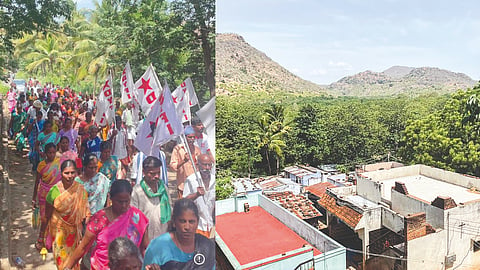
“Bureaucrats view the forests and the people who depend on them for their livelihoods through a colonial lens to them, we are encroachers who should be uprooted at any cost,” said scores of forest dwellers, who participated in a solidarity march organised by the DYFI across the mountain villages of Varusanadu on August 29, demanding protection of their land and livelihoods from eviction.
The Supreme Court, in its direction issued on May 29, 2026, warned of deploying paramilitary forces to remove 4,600 families residing in the Srivilliputhur-Megamalai Tiger Reserve, who were identified as encroachers based on the recommendations of the Central Empowered Committee (CEC). The Court also directed authorities to clear kapok cultivation and disconnect electricity and water connections to encroached structures. The compliance hearing is scheduled for September 8.
“We’ll not leave this place. We’ve lived here for generations, and our forefathers taught us to consider this land sacred. Let them take our land after killing all of us,” said elders, women and children among the hundreds of traditional forest dwellers, who marched along the hilly roads towards Varusanadu town.
A loudspeaker mounted on a van travelling ahead of the procession played songs celebrating the people’s centuries-old love and attachment to the land. “See, this forest is our soul. We do not see ourselves as separate from it. This flora and fauna, birds and animals, air and water constitute us. How can the court call us outsiders?” fumed 76-year-old Sini Muppur from Veera Chinamalpuram village, who says he was just five years old when his family migrated to the hills with his great-grandfather Kayakudi.
Sini says he is the third generation in his family. “This forest was under the Gandamanayakanur Zamindar when we settled here,” he stated. “I still remember that, through a thandora (drum), a message was spread in weekly markets in places such as Usilampatti, Uthamapalayam, Theni and Cumbum, urging people to come and settle in the Varusanadu hills.”
It was a period of acute poverty, and it was difficult even to have a meal a day. “We didn’t own land; we were all agricultural labourers. If the entire family worked from early morning until sunset in the agricultural fields, we would be paid just Rs 5,” said Panjagam (76) from Selamuthaipuram village.
Karuppayya (82), from the same village, recalled, “You wouldn’t understand what hunger meant then. With this meagre amount, we had to feed 8 members of a family. Many times, elders in the family would feed their children, and then sleep with a towel soaked in water over their stomachs to fight hunger.”
Like Sini’s family, Panjagam and Karuppayya’s great-grandfathers brought their families from Cumbum to these hills to escape poverty. But it was not just these three families. Thousands of subalterns, mostly daily-wage labourers, migrated from the interior villages of the erstwhile Madurai district, which comprised the present-day Theni revenue district, and settled in 98 hamlets spread across nine panchayats, including Megamalai, Varusanadu and Thummakundu, in the Kadamalaikundu-Myladumparai Union. The accounts of residents suggest that the migration dates back nearly two centuries.
“We came not in search of economic prosperity, but simply to stay alive,” said Chinna Amma (80), her face grim as she walked down memory lane. “There were no roads, shops, electricity or houses when we came here. It was just us and these hills.”
There were bushes and trees everywhere. “We cleared some areas and ploughed them to cultivate samai (little millet), kuthiraivali (barnyard millet), thinai (foxtail millet) and kezhvaragu (finger millet). We got just 10 bags of grain in a year,” said Panjagam. “These were just enough to meet our food needs. We never thought of having anything more.”
Over the years, as millet cultivation could not provide them with sufficient income to cope with the demands of a cash-driven economy, these people shifted from millets to cash crops such as lemongrass, silk cotton, cotton and cashew. Yet, they remained largely cut off from the outside world.
“In those days, the Vaigai River would flow for nearly 6-8 months in these areas, where it originates. Crossing the river to reach Varusanadu or Kadamalaikundu to sell agricultural produce remained very difficult for them,” recalled T Kannan (69), district secretary of the Tamil Nadu Vivasayigal Sangam, Theni.
Kannan, from Jayamangalam village near the Vaigai dam, first visited these hills in the mid 1980s. He and other CPI (M) cadres were shocked to see K Veerayan, a former MLA, returning from an inspection of the Varusanadu hills completely drenched, with his white shirt and dhoti turned red from the soil.
Veerayan was part of a committee constituted by the then Chief Minister MG Ramachandran, popularly known as MGR, to tour the 98 hills of the Megamalai-Varusanadu region and recommend measures to improve the socio-economic conditions of these people, he recalled.
MGR won the Assembly election from the Andipatti constituency, which comprises Varusanadu and Thummakundu in the Kadamalaikundu-Myladumparai Union, in 1984 while recuperating at the Brooklyn Hospital in the United States. “MGR was moved by the love and affection shown by these people and was also deeply concerned about their backwardness when he came to address a public meeting at Andipatti after recovering from his illness,” said a retired senior government officer who hails from the region.
What followed was the construction of bridges across the Vaigai river, electricity connections, laying of roads on patta land and distribution of house pattas to people in some hill villages. “If we’re encroachers, as claimed by the Court now, how did the then CM MGR provide house pattas, bridge connectivity and power supply to us?” asked Panjagam (76), referring to houses in Selamuthaipuram village.
Successive governments also established schools, ration shops, anganwadi centres and drinking water facilities in many villages, but the Forest Department did not express any objections to these activities at the time, said the villagers.
The first list of 1,595 encroachers released by the district administration for eviction included the names of 14 members of the Paliyar tribe from Nochiyodai tribal hamlet in the Varusanadu hills. Ironically, authorities had granted them individual pattas under the Forest Rights Act (FRA), 2006, between 2018 and 2023.
“We had applied for FRA pattas for 29 families living in Nochiyodai tribal hamlet in 2010. After a lot of struggle, we secured FRA pattas for 18 members, as well as community rights under the FRA for all families, which give these tribes legal rights to manage and protect their traditional community forest land and resources,” said S Thanaraj, a tribal rights activist.
“What is troubling me most is that this list was prepared after the Central Empowered Committee visited the area and discussed with officials how to identify genuine encroachers. It raises questions about the mechanism they followed to identify the encroachers. Did they really look into the FRA?” he asked. “Even if tribal forest dwellers did not have pattas, they should not be considered as encroachers under the FRA.”
This clearly shows the Forest department's intention to evict the tribal people, which according to Thanraj, started after the State government declared it as a Reserve Forest in 2009. Subsequently it was declared as Megamalai Wildlife Sanctuary in 2009 and later, as the Srivilliputhur-Megamalai Tiger Reserve in 2021.
The situation appears to be the same for non-tribal traditional forest dwellers. “Many ask us why we did not obtain land pattas when the government appointed a settlement tahsildar long ago to settle our patta claims. But our answer is that we’re illiterate, tied to the land. Moreover, we do not have sufficient money to pursue the claims,” said several elders aged above 70 living in the hills.
After the Zamindari system was abolished and the land was brought under the Tamil Nadu Estates (Abolition and Conversion into Ryotwari) Act, 1948, eligible occupants became entitled to Ryotwari pattas. “In 1967, during the DMK regime, they gave us pattas. Some people who could afford the expenses managed to get pattas, but many could not. The process is cumbersome,” laments Panjagam.
As mentioned earlier, there was no road connectivity to these places. “In such a situation, we had to make arrangements for a land surveyor to come to our land, bring the survey chain to measure it and pay Rs 25, besides providing food for him,” he said.
“When we’re cut off from the mainland, how is it possible for all the people living in the interior hills to know all these procedures?” questioned the elders. “Our understanding of land ownership was minimal. All we knew was to work hard and earn enough to feed our families,”.
Farmers say that Forest officials visit their villages once every 15-20 days. “If they found us cutting one or two trees, they would ask for money. We would pay them, and then they would leave. Now we’re called encroachers. Even if we cut a tree, we’ll plant another one elsewhere because this forest has given us life for generations,” said women farmers from Vandiyur village.
The village has a ration shop, a government school and facilities for the younger generation to flourish. “Since 2009, we’ve constantly lived in fear because the Government stopped all development activities after that. Now, we’re ready to die on the land where we were born,” said the group of women with grim faces.
People living in the 98 hills are anxious over their loss of living space because successive governments have viewed them primarily through the lens of electoral benefits, while the bureaucracy has continued to function with a colonial mindset, environmental activists alleged.
“The forests in India belong to indigenous people who have lived there for centuries, preserving them rather than exploiting them, as claimed by bureaucrats. It was the British Raj that first introduced the Tamil Nadu Forest Act in 1882 to exploit the country’s natural resources and forcibly evicted large numbers of tribal people and other traditional forest dwellers who depended on the forests,” explained CR Bijoy, a prominent environmental activist.
“The Megamalai-Varusanadu hills, where the Vaigai originates, have a long history of human settlement. Even today, artefacts can be found there. The Tamil Nadu Department of Archaeology and the Archaeological Survey of India have identified more than 100 megalithic sites,” pointed out Pavel Bharathi, founder of the Archaeological and Cultural Forum for Vaigai. “These sites can be dated back to around 1000 BC.”
The British introduction of the the draconian Criminal Tribes Act in 1871, which criminalised entire communities in India and targeted the Piramalai Kallar community in the Usilampatti region, forced many of them to migrate to these hills. “A large number of people migrated to these hills during the Madras Famine of 1876-78,” said Pavel.
Against this backdrop of historical injustice done to tribes and traditional forest dwellers across the country, the Central government enacted the Forest Rights Act (FRA), 2006, to safeguard the traditional rights of tribal people and forest dwellers. “The Act recognised traditional forest dwellers as an integral part of the forest ecosystem,” said Bijoy. “Under the FRA, claims over forest land must first be examined by the Gram Sabha (village assembly), followed by the Sub-Divisional Level Committee (SDLC) and finally by the District Level Committee (DLC). Neither bureaucrats nor courts are empowered to determine whether a person qualifies as a traditional forest dweller.”
Additionally, countering Forest official’s claims under section 4 notifications in 1978 under Tamil Nadu Forest Act 1882, only 168 claims were received and considered for Patta, a government officer, said that the then Madurai district Collector had reported to the State Government on June 16, 1970, that there were 7,964 occupants in this region who demanded rights over pattas, not leases.
“Accordingly, the Collector, on June 30, 1970, recommended issuing pattas. Therefore, the forest officials’ allegation that the encroachers are subsequent encroachers are without any basis,” the officer said. “No notice was served on those 7,964 occupants as warranted under Section 6 of the Tamil Nadu Forest Act.”
“What we’re requesting the court is to provide sufficient time for the people who have been identified as encroachers, including 118 government employees, to establish their claims under the FRA,” said Maruthu Pandi, secretary of the Traditional Forest Dwellers’ Rights Association, adding that they also support the removal of illegal encroachments and the preservation of the forest.
Justices Vikram Nath and Sandeep Mehta ordered the demolition of illegal lodges, resorts, and commercial plantations on protected forest land, alongside cutting off electricity and water supplies to these areas
All government establishments, public utilities, and unauthorised infrastructure within the Tiger Reserve be discontinued, relocated, dismantled, or removed within 6 months
TN told to initiate disciplinary and legal action under the Tamil Nadu Government Servants’ Conduct Rules against 118 serving and retired government employees identified as encroachers