
- Chennai
- Tamil Nadu
- India
- World
- EntertainmentEntertainment
- Business
- Sports
- Lifestyle
- Technology
- Videos
- Explainers
- Editor's Picks

CHENNAI: “What happened to my elder sister?” This was 19-year-old Bharat Juanga’s first question when DT Next contacted him on the phone, to ask him about his return to Odisha, even as his sister Padmini, 21, one of the victims of last week’s ammonia tragedy that claimed 15 lives, is still in intensive care at a Chennai hospital.
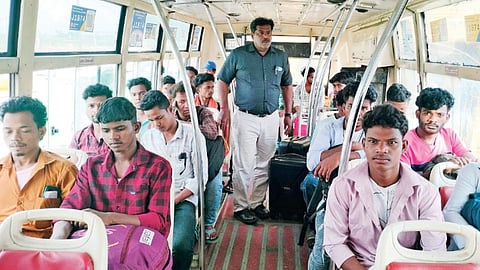
When DT Next called him, Bharat was on the Bhubaneswar Express to Odisha, along with many other workers of the seafood unit that was struck by the gas leak to be sent home against their wishes.
“The police told us she was fine, but they wouldn’t let us see her,” Bharat said. As the conversation ended, he circled back to the same question: “What happened to my sister? Please tell me.”
Nearly 1,500 km away, another worker from Odisha carried the same uncertainty. Sumant Juanga said his 21-year-old wife, Sima Juanga, was among those hospitalised. “They didn’t allow me to see her even once,” he said. According to Sumant, even Sima’s father had travelled from Odisha after learning of his daughter’s condition, but was unable to meet her.
The experiences of Bharat and Sumant point to a common concern among several migrant workers interviewed by DT Next in the days following the accident. Sixty-two workers from the seafood processing unit, all from Odisha, returned home state, while some of their close family members remained under treatment in hospitals across Chennai and Tiruvallur.
Neither Bharat nor Sumant asked about compensation or employment, but repeatedly sought updates on the loved ones they were forced to leave behind. Bharat and Sumant, like scores of other workers employed at the unit, belong to the Juanga tribal community from Keonjhar district, where labour contractors recruit workers for factories in southern India. Around 10 young men and women from the same village travelled together to work at the factory. Two from the group died, while six others remain hospitalised.
While Bharat and Sumant don’t know who sent them back or why, an official with the TN labour department told DT Next it wasn’t the government. Labour lawyers point to broader questions over compliance with labour laws. The Employees’ State Insurance Act requires coverage for any factory employing more than 20 workers. It had not been applied here. “They didn’t register. They didn’t deduct the percentage for contributory insurance from the workers’ salaries,” says Shreela, a labour advocate. She noted the contractor had altered identities and even age of workers while recruiting them. For all you know, many could be under-aged.
Workers were paid in cash, which is prohibited under the Payment of Wages Act for those on monthly wages. No pay slips were issued. Wage registers, digitised attendance records, or authentic employment documents, were not maintained she said.
"The police told us she was fine, but they wouldn’t let us see her. What happened to my sister? Please tell me" asked Bharat, whose sister is hospitalised in Chennai.
The workers were employed on 12-hour shifts: 9 am to 9 pm for seven days a week, with no weekly off. The only way to earn a day’s rest, Bharat said, was to work a double shift. Even then, no additional wages were paid. “Just Rs13,000,” he said. “If you just look at how they have worked and what the wage was, it’s obvious that it is under the minimum wage,” Shreela said. She also alleged that the contractor had altered workers’ identities and ages while recruiting them.
“The contractor has forged their names, changing their ages and names to bring them here,” she said. Referring to the working hours, wages and recruitment practices described by workers, Shreela said, “If this isn’t bondage, then what is?”
A revenue official who spoke to DT Next also acknowledged that authorities were examining identity-related issues. “It’s difficult to verify,” the official said.
In the days following the accident, workers evacuated from the unit were housed in a nearby mandapam under district administration care. While journalists, labour activists and lawyers were restricted from interacting with them, the company’s General Manager continued to have access to the shelter for at least two days. Video recordings reviewed by DT Next show the manager speaking harshly to workers. Meanwhile, several workers said they were unable to meet hospitalised relatives. Labour rights advocates also questioned the absence of the Labour Department.
A senior Labour Department official, speaking to DT Next disputed the allegation that workers had been forced to return. "We have not forcefully sent them back," the official said, adding that alternative employment had been offered at other companies, accommodation and food had been arranged, and the Collector had personally persuaded workers to stay. "When they want to go, we cannot compel them." Officials from the Odisha government travelled to Tamil Nadu and facilitated the return.
However, Bharat and Sumant maintained that they had boarded the train without being allowed to meet their relatives. When this was put to the official, he acknowledged, “They were informally telling they wanted to see their families,” but did not explain why they were unable to do so.
The official confirmed that cases had been registered under multiple provisions, including child labour, safety and payment-of-wages violations.