
- Chennai
- Tamil Nadu
- India
- World
- EntertainmentEntertainment
- Business
- Sports
- Lifestyle
- Technology
- Videos
- Explainers
- Editor's Picks

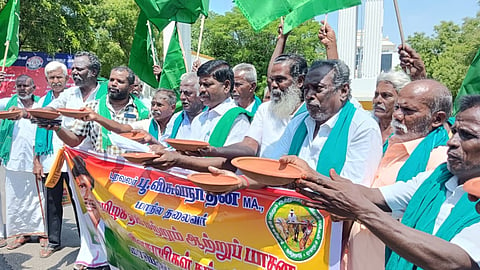
TIRUCHY: Farmers across the state are opposed to the TVK government’s crop loan waiver with certain Santhconditions, as they have enjoyed more benefits from earlier governments, dating back to 2006.
The DMK government then had introduced the universal waiver for all loans, and in 2016, the AIADMK government wrote off all loans for small and marginal farmers. This pattern continued by both AIADMK and DMK, who were ruling the state, despite an RBI regulation through NABARD in repayment norms.
The farmers, who are dissatisfied with the present announcement, have appealed to the TVK government to at least compare the scale of finance approved by the Cooperative department on paddy irrigation.
As more than 70 per cent of people across the country are involved in agricultural activities, the farm loan waiver has a long history in the electoral politics in the country, particularly in Tamil Nadu.
The senior agricultural experts pointed out that there are 1.03 lakh Primary Cooperative Credit Societies with 14.03 crore membership among which as many as 4,471 Primary Cooperative Societies are functioning in Tamil Nadu, through which an annual crop loan of up to Rs 30,000 crore is disbursed.
Dating back, there has always been trouble in repayment of loans availed by the farmers, and the respective governments started to derive a formula for solving the dispute. The governments attempted to provide certain rebates to the farmers who had a track record of prompt repayment of loans. However, during the Vajpayee-led NDA rule, the cooperative credit societies struggled a lot due to the non-repayment of loans.
The subsequent UPA government had disbursed a fund to the tune of Rs 13,000 crore to revive the struggling societies, but with a condition that the respective state government sign an MoU with the NABARD. By the conditions, the state governments were responsible for repaying the funds released for agricultural loans from NABARD. The loan had to be repaid by the respective state governments within a certain period.
In 2001, the then AIADMK government refused to sign the agreement, and the then Chief Minister J Jayalalithaa claimed that the Centre was waging a financial war against the state governments.
However, in 2006, the successive state government formed by DMK signed the agreement and the then Chief Minister M Karunanidhi made a historical announcement of writing off all types of agricultural loans short term, medium term and long term — for all categories of farmers, regardless of the size of landholders to the tune of Rs 7,000 crore and this was for the first time that a State government waived farm loans released through the cooperative banks by farmers. Since then, the loan waiver has been a major demand of the farmers.
Since the crop loan waiver took centre stage during every election campaign, AIADMK, which formed the government in 2016, waived off the crop loan to the tune of Rs 5,780 crore but restricted the waiver to small and marginal farmers who had less than five acres of land.
In February 2021, the then Chief Minister Edappadi K Palaniswami announced a crop loan waiver to the tune of Rs 12,110 crore, but he could not continue to waive completely. The following DMK government, led by MK Stalin, had completed the entire Rs 12,110 crore as soon as he assumed office and an additional waiver of Rs 2,755 crore was availed by Women Self Help Groups through Cooperative societies and jewel loans to the tune of Rs 6,000 crore.
Meanwhile, the previous DMK government had repaid the waived-off funds to the tune of Rs 21,000 crore as per the RBI direction through NABARD.
Meanwhile, the NABARD had revised its regulation in November 2025 that no state government is allowed to write off agricultural loans without the permission of the authorised board. If the state government goes ahead with the loan waiver without permission, they need to repay the fund within 60 days of fulfilling the waiver.
“This has restricted the newly formed TVK government. Fulfilling the promise of loan waiver to the farmers became difficult, and so the writing off of the all-time small fund of Rs 2,044 crore, with the categorising of farmers became a debatable subject,” a senior agricultural researcher said.
He also opined that, despite the state government following the regulations set by NABARD, it should have considered the scale of finance for 2025-26 approved by the State Level Technical Committee (SLTC) of Tamil Nadu Cooperative Department.
The committee had set the cultivation cost of paddy in the North Eastern zone of Tamil Nadu as Rs 36,300 per acre, the North Western Zone Rs 38,300 per acre, the Western Zone Rs 38,500 per acre, the Delta region Rs 37,600 per acre, the South Zone Rs 36,000 per acre and the Hills Rs 35,000 per acre.
“Otherwise, the loan waiver would never help the farmers”, the researcher said further.