
- Chennai
- Tamil Nadu
- India
- World
- EntertainmentEntertainment
- Business
- Sports
- Lifestyle
- Technology
- Videos
- Explainers
- Editor's Picks

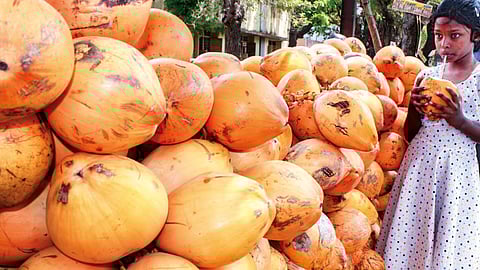
COIMBATORE: A blistering summer has sparked a surge in demand for tender coconuts from Pollachi, but a sharp fall in production, driven by drought, pest attacks and labour shortages, has tightened supply and pushed prices upward.
Farmers and traders say the current season has been particularly harsh. While summer typically sees a dip in yield, this year’s prolonged dry spell and extreme temperatures have significantly worsened the decline, affecting both output and quality.
“The yield of tender coconuts has gone down by 25 per cent compared to last summer. At present, around 1.5 lakh tender coconuts are harvested daily from Pollachi, Udumalpettai and nearby regions, down from nearly two lakh last year. During peak winter months, arrivals usually touch six lakh per day,” said Srinivasan AE, the president of Anaimalai Tender Coconut Growers Association.
The shortfall has translated into higher prices in retail markets. In Coimbatore, tender coconuts are currently priced between Rs 60 and Rs 70 a piece, while the farm gate price stands at around Rs 49 per nut. A tonne of first-quality coconuts costs around Rs 19,250. Farmers claim that prices could climb further in May and June, when temperatures rise across major consumption centres such as Chennai and northern India.
Heat stress has also reduced the water content and weight of each tender coconut, further impacting marketable yield. Unlike last year, when sporadic April showers offered some relief, this season has remained largely dry.
Earlier, a good yield lasted for about six months in a year. Now it has shrunk to just three months. A tree that once yielded 250 tender coconuts annually now produces barely 150
M Anandaraj, a coconut exporter
Water scarcity has compounded the crisis. Farmers say only plantations near canals and rivers have access to reliable irrigation, while others depend on costly tanker water to keep trees alive. “Buying tanker water frequently is not viable. Many farmers purchase water occasionally to prevent trees from drying up,” said R Surendran, a coconut grower in Kinathukadavu near Pollachi.
Labour shortages have added to the strain, with many workers currently engaged in election-related activities, slowing harvesting and supply operations. Adding to the strain is a decline in productivity. Farmers report that multiple factors, ranging from pest attacks like whiteflies to root wilt disease and adverse climatic conditions, have reduced the productive cycle of coconut trees.
“Earlier, a good yield lasted for about six months in a year. Now it has shrunk to just three months. A tree that once yielded 250 tender coconuts annually now produces barely 150,” M Anandaraj, a coconut exporter, said.
Despite the constraints, demand for tender coconuts continues to climb nationwide, fuelled by rising awareness of their health benefits as a natural alternative to aerated drinks. “E-commerce platforms such as Amazon and Blinkit have become major buyers, sourcing huge volumes of tender coconuts daily from Pollachi and surrounding areas. They have been procuring directly from farmers for several years, and their demand is increasing year on year,” Srinivasan added.
Exporters, however, note a brief dip in demand during the election period due to cash flow restrictions under the Model Code of Conduct. “Farm gate prices dropped by around Rs 2 per kg during the poll month, but they are expected to rise again with the continuing heat. Even so, tender coconuts are fetching higher prices this year compared to previous seasons,” said Anandaraj.
Pollachi’s tender coconuts are supplied across India and also exported to neighbouring countries. With demand for tender coconuts steadily rising, the cultivation area is expanding steadily in Pollachi due to assured returns for farmers.