
- Chennai
- Tamil Nadu
- India
- World
- EntertainmentEntertainment
- Business
- Sports
- Lifestyle
- Technology
- Videos
- Explainers
- Editor's Picks
CHENNAI: In a move to clear the ecologically sensitive Western Ghats landscape of alien invasive plant species as well as to earn revenue, the State Forest Department has decided to establish a biochar manufacturing facility inside Sathyamangalam Tiger Reserve (STR), which will covert invasive species into biochar, a carbon-rich charcoal.
Under the project, the department will employ local tribal groups and rural communities in harvesting invasive plants and convert them into biochar using pyrolysis technology at low oxygen atmosphere.
The project will be implemented at Rs 8.50 crore. “The pyrolysis plant enables controlled processing with emission management, converting a large volume of low-value biomass into a high-value, stable carbon product. Most importantly, the quantifiable, long-term carbon storage in biochar can be monetised through carbon credit markets,” as per a department document.
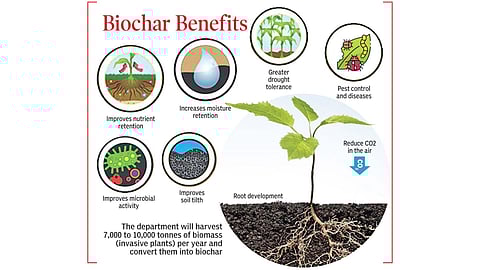
The department will harvest 7,000 to 10,000 tonnes of biomass (invasive plants) per year and convert them into biochar. Biochar is a stable carbon -rich material that enhances soil fertility, sequesters atmospheric carbon dioxide, and generates high-value carbon credits under the Voluntary Carbon Market (VCM).
According to the document, STR, which is located in the Erode district, at the junction of the Western and Eastern Ghats, is crucial for ensuring long-term genetic connectivity among large mammals and for the overall conservation of biodiversity in southern India. But, the landscape is infested with invasive alien species such as Neltuma juliflora, Lantana camara, Senna spectabilis and Opuntia spp.
“These invasive species have spread widely across dry deciduous forests, scrublands, and grasslands, reducing native floral diversity and the availability of fodder for wild herbivores. This loss directly impacts key species that rely on a mix of open and lightly wooded habitats, undermining the landscape’s role as a vital wildlife corridor between the Western and Eastern Ghats,” the document said.
The department believes that the biochar plant will result in removal of more than 70,000 tonnes of invasive biomass over 10 years, reduction in open burning and GHG emissions and sequestration of approximately 3,000 tonnes of carbon dioxide equivalent annually apart from restoring the biodiversity of STR and adjoining areas.
Present, ‘cut, remove and sell as firewood’ adopted by the department in many parts has several restrictions including limited revenue and difficulty in repeated follow-up removal, which would result in re-sprouting. Also, firewood sale would lead to emissions at the end-user level.
What is biochar?
Biochar is a stable, charcoal-like carbon material made by heating organic matter (biomass like wood, crop waste) in a low-oxygen environment (pyrolysis), primarily for soil improvement and long-term carbon storage (sequestration). It's highly porous, has a large surface area, and can dramatically improve soil fertility, water retention, and nutrient uptake, lasting for centuries, unlike compost. It's also a climate change mitigator, locking carbon away while potentially producing clean energy co-products.
