
- Chennai
- Tamil Nadu
- India
- World
- EntertainmentEntertainment
- Business
- Sports
- Lifestyle
- Technology
- Videos
- Explainers
- Editor's Picks

CHENNAI: Tamil Nadu faces severe SIPCOT industrial land constraints in some established industrial centres, even as the State reports more than Rs 11 lakh crore in investment commitments, according to a CREDAI Tamil Nadu report prepared by JLL Research.
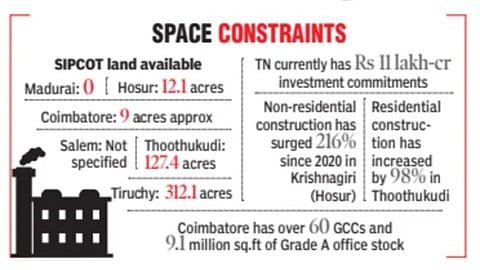
The report, Tamil Nadu 2036: Building the Next Decade, says Coimbatore and Madurai have between zero and nine acres of SIPCOT land remaining, while Hosur has 12.1 acres left. By comparison, Tiruchy has 312.1 acres available, and Thoothukudi has 127.4 acres.
Tamil Nadu's SIPCOT network comprises 50 industrial parks, including eight special economic zones, across 24 districts, covering 48,900 acres, but the report identifies the near-exhaustion of public industrial land in established markets as a factor drawing institutional investment into private, Grade-A industrial facilities.
The land constraints come as the State reports over Rs 11 lakh crore in investment commitments over five-and-a-half years. Of 1,283 MoUs signed during this period, 867 projects advanced to implementation and potentially generate more than 37 lakh jobs. The report says 35 per cent of committed projects were operational.
Industrial expansion is also putting pressure on supporting infrastructure. In Krishnagiri district, which includes Hosur, non-residential construction grew 216 per cent since 2020, the highest among the cities profiled. The report identifies a gap between investment growth and the availability of housing and worker accommodation.
The report examines six cities, including Coimbatore, Madurai, Tiruchirappalli, Hosur, Salem and Thoothukudi, whose industrial bases and infrastructure differ.
It identifies Tiruchy and Thoothukudi as having larger remaining SIPCOT land banks, while Coimbatore has developed a substantial office market, with more than 60 operational global capability centres and 9.1 million sq. ft of Grade-A office stock.
Housing development, meanwhile, remains heavily land-led in these cities. Plotted layouts account for between 79 per cent and 88 per cent of residential launches across the corridors examined by the report.
As Tamil Nadu works towards its $1.5 trillion ambition by 2036, the focus must be on faster approvals, land pooling, transit-oriented planning and housing that remains within reach
WS Habib, CREDAI Tamil Nadu president
Chennai accounts for 51.5 per cent of the state's residential launches, compared with 25 per cent in the west zone, 22.1 per cent in the south and 1.4 per cent in the north.
Commenting on the report, WS Habib, president, CREDAI Tamil Nadu, said, "The state's growth story is no longer Chennai's alone.
Coimbatore, Madurai, Tiruchy, Hosur, Salem and Thoothukudi are growing simultaneously, creating new opportunities for organised real estate development across the state.
As Tamil Nadu works towards its $1.5 trillion ambition by 2036, the focus must be on faster approvals, land pooling, transit-oriented planning and housing that remains within reach."