
- Chennai
- Tamil Nadu
- India
- World
- EntertainmentEntertainment
- Business
- Sports
- Lifestyle
- Technology
- Videos
- Explainers
- Editor's Picks
NEW DELHI: The Supreme Court on Wednesday frowned upon the "unwritten ban" imposed by the Tamil Nadu government on fishermen by not granting access passes for using purse seine nets in the Centre's Exclusive Economic Zones (EEZ), and said it is necessary for the Union and the state to abide by the principle of cooperative federalism.
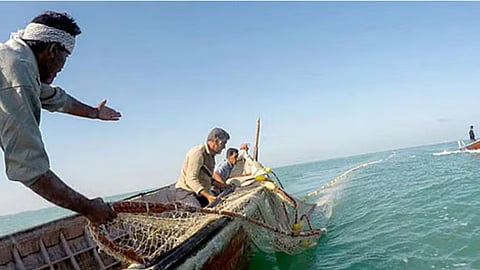
Purse seine fishing is a method that uses a vertical net attached to a vessel to encircle schools of fish in open water.
A bench of Justices P S Narasimha and Alok Aradhe ruled that the rights and liabilities of the parties will now be governed according to the relevant laws, EEZ Rules, 2025 and the Tamil Nadu Marine Fishing Regulation Rules, 2020.
The bench said laws, rules and regulations addressing the issue of access to the EEZ for fishing using purse seine nets and transiting through the territorial waters of the state have come into force and are operating.
"For effective and efficient implementation of these rules and regulations, it is necessary for the Union and the State to abide by the principle of cooperative federalism. The Union as well as the state administration are the duty bearers not only to implement the respective regulations within their province, but also to ensure that the stakeholders have easy access and efficient clearance of their applications to pursue their fundamental rights under Article 19(1)(g) of the Constitution of India, of course subject to reasonable regulations," it said.
Giving a reality check, the bench said the status of applications for access passes under the EEZ Rules, 2025 on the Registration and Licensing of Fishing Craft Portal (ReALCRaft Portal) as on August 3, 2026 is rather "disturbing" and demonstrates a "lack of coordinated endeavour" between the issuing authority appointed by the Union and the verifying authority of the state, who is a state government official.
The top court flagged that out of 257 applications made, almost 226 applications are still pending verification by Tamil Nadu.
"It appears that only six access passes have been issued. This is said to be the lowest among all coastal states. Not processing the applications in time virtually amounts to imposing an unwritten ban, which is impermissible in law," it said.
The bench said, "The state of Tamil Nadu is directed to ensure effective, efficient and timely clearance of the applications as per the rules and regulations which govern the subject."
It further directed the state government to frame necessary rules/ regulations designating a specified channel under Rules 15(5) and (6) of the Marine Fishing Regulation Rules, 2020 for transit of vessels from its territorial waters to the EEZ for fishing using purse seine nets.
"These rules/ regulations may be made after taking into account the final recommendations of the expert committee," the bench said, while disposing of a batch of pleas filed by fishermen and a NGO challenging the regulations of the state government, banning purse seine fishing.
The bench noted that the expert panel constituted by the court earlier has broadly said that purse seine nets do not cause any major environmental harm in the maritime zones on the population of fishing stocks. The panel has suggested no outright blanket ban on purse seine fishing but it was of the view that there must be effective regulation on the use of these nets, it said.
The bench said the powers of both the Union and the state are equal and autonomous in each of their legislative spheres.
On August 4, the top court, while reserving its decision, had told the state government that fishermen must be allowed to go for purse seine fishing beyond the state's territorial waters but any such activity should be within the exclusive economic zone with due permission.
It had said if fishermen doing purse seine fishing violate the norms of the state within its territorial waters, they can be arrested.
The NGO 'Fisherman Care' alleged that the state was neither allowing it to do fishing in its territorial waters nor was it allowing them to go beyond 12 nautical miles in the Centre's jurisdiction of the exclusive economic zone.
On January 24, 2023, in a relief to fishermen, the top court conditionally allowed purse seine fishing beyond the territorial waters of the state but within the exclusive economic zone of the Centre.
It had noted that some coastal states like Gujarat, Kerala, Andhra Pradesh, Odisha, Karnataka, Goa and West Bengal do not have any restrictions on this type of fishing within their territorial waters.
The top court had formed an expert panel which had suggested that a ban on purse seine fishing was not justified and may be allowed with a proper access plan for the fishermen.
The top court had said that the fisheries department will give permission to only those boats where an approved vessel tracking system has been installed and which shall be kept running during the operating time of the vessels.
The state government had contended that fishing entities could use their vessels with purse seine nets in the territorial waters itself while proceeding to the EEZ and their concern was that under the guise of fishing in the EEZ, the fishermen could employ purse seine nets within 12 nautical miles.
