
- Chennai
- Tamil Nadu
- India
- World
- EntertainmentEntertainment
- Business
- Sports
- Lifestyle
- Technology
- Videos
- Explainers
- Editor's Picks

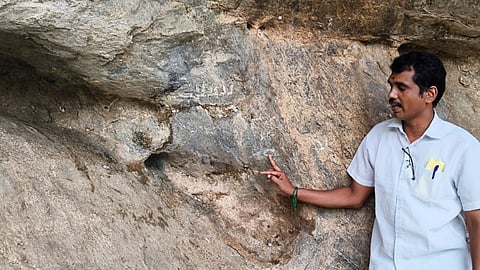
The discoveries were made during a surface exploration led by archaeologist T Muneeswaran, along with researchers Rajesh Kannan, Palani and Vigneshwaran. The team identified a long natural cave, white rock paintings and evidence of ancient iron production on the southern side of the hill.
Muneeswaran, assistant professor of History at the Government Arts College for Women, Sivaganga, said the cave, measuring about 20 feet in length and seven feet in width, contains faded white and red ochre paintings, indicating that it may have served as a habitation site for prehistoric people. The cave, now locally known as Umai Pondhu, has been partially damaged over the centuries due to water erosion.
The newly documented white rock paintings depict a reptile-like figure, a long-necked stick-like human figure in a dancing posture and several symbols. Based on their characteristics, the paintings are estimated to date back about 3,000 years, he said.
The survey also found iron slag and fragments of baked-clay tuyeres, which were likely used to channel air into furnaces during the iron-smelting process. The findings suggest that the inhabitants possessed the knowledge to extract and smelt iron from locally available iron-bearing rocks to manufacture iron implements.
Acknowledging the significance of the discovery, renowned art historian Gandhirajan KT said an examination of the cave paintings suggested that the site could date back to around 3,000 BCE or even earlier.
"Though the number of paintings is less in number, they reflect the creative expression of ancient communities. Carrying out systematic surface explorations along the Western Ghats in southern Tamil Nadu is important, as it could help establish ancient trade routes between present-day Tamil Nadu and Kerala long before the formation of the modern states," he said.
He added that archaeologists should also document local oral traditions and folklore associated with the area to help reconstruct its historical past.