
- Chennai
- Tamil Nadu
- India
- World
- EntertainmentEntertainment
- Business
- Sports
- Lifestyle
- Technology
- Videos
- Explainers
- Editor's Picks

CHENNAI: Like Shiv Sena founder Bal Thackeray in Maharashtra, PMK founder S Ramadoss wielded enormous political influence without ever occupying the Chief Minister's chair, but he had to quit politics on his 88th birthday, indirectly accepting defeat at the hands of his son Anbumani Ramadoss, with whom he fought a full-fledged war that culminated in his drubbing in the recently concluded Assembly polls.
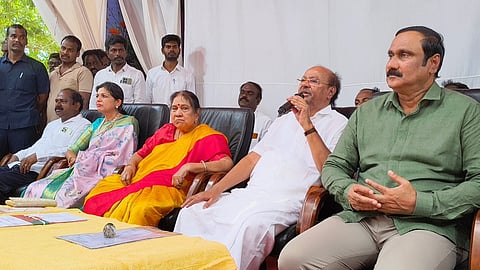
For more than three decades, Ramadoss senior shaped the State's coalition politics, built a party around the Vanniyar assertion often at odds with oppressed Dalit communities and frequently influenced political equations despite the PMK's limited electoral strength and restricted presence. On his 88th birthday on Saturday, Ramadoss formally retired from active politics, handing over all political and organisational responsibilities to his son, Anbumani Ramadoss, marking the end of an era for the party and the leader.
The announcement also formally ended a prolonged leadership battle between the father and son that had split the PMK, triggered legal disputes and cast doubts over the party's political future.
Ramadoss said Anbumani would henceforth lead the party, while he is expected to remain its ideological guide. The transition places the responsibility of reuniting cadres, rebuilding the organisation and expanding the PMK's electoral base squarely on Anbumani, leaving Ramadoss's loyalists who sided with him in limbo.
The feud erupted in December 2024 after Ramadoss appointed his grandson, Mugunthan Parasuram, as the party's youth wing president, sparking an open confrontation over organisational control. Rival meetings, conflicting statements and competing leadership claims followed, with both factions approaching the courts over the legitimacy of organisational decisions.
The split was reflected in the 2026 Assembly elections. Anbumani led the PMK faction that contested as part of the AIADMK-led NDA, winning four of the 27 seats it contested. Ramadoss aligned with VK Sasikala, with his faction contesting 32 seats but failing to retain deposits in any constituency. The results cemented Anbumani's political dominance within the party.
The rift ended in June 2026 during the 61st wedding anniversary celebrations of Ramadoss and Saraswathi, when the father and son publicly embraced and reconciled. Ramadoss subsequently withdrew the cases filed against Anbumani, paving the way for the reunification of the party.
A medical practitioner by profession, Ramadoss entered public life through the Vanniyar Sangam movement in the 1980s, campaigning for reservation and greater political representation for the Vanniyar community. He founded the Pattali Makkal Katchi (PMK) in 1989 and transformed it into a key force in the State's coalition politics over the next 37 years, switching sides at every opportunity while using Vanniyar caste identity and regionalism as a trump card.
Though the PMK never emerged as a dominant electoral force independently, it repeatedly played a strong role by aligning with arch-rivals the DMK, AIADMK and the BJP-led National Democratic Alliance at different points since the 1998 Lok Sabha elections. The shifting alliances invited criticism from political opponents, who accused the party of opportunism, but the core vote bank never complained, making it easy for the patriarchal set-up. Ramadoss maintained that every alliance was guided by the interests of the State and the party's long-term political objectives.
Beyond electoral politics, Ramadoss championed education, prohibition, public health, environmental protection and farmers' welfare. However, after the 2011 Assembly elections, the PMK faced sustained criticism from political observers, Dalit organisations and human rights activists over its caste politics. Critics accused the party of mobilising non-Dalit communities, seeking amendments to the SC/ST (Prevention of Atrocities) Act and opposing inter-caste marriages. Dalit groups also linked the party's rhetoric to the 2013 Mamallapuram and Marakkanam caste clashes, allegations consistently denied by the PMK.
Meanwhile, PMK honorary president GK Mani skipped Saturday's event, fuelling speculation over the party's internal realignment. Party sources said Anbumani is expected to restructure the organisation in the coming months, and the proposed changes are believed to have contributed to Mani's absence.
With Ramadoss stepping away from active politics, Tamil Nadu closes the chapter on one of its most influential regional political strategists, leaving Anbumani to determine whether the PMK can regain its relevance in an increasingly competitive political landscape.