
- Chennai
- Tamil Nadu
- India
- World
- EntertainmentEntertainment
- Business
- Sports
- Lifestyle
- Technology
- Videos
- Explainers
- Editor's Picks

CHENNAI: The discovery of megalithic burial urns, ritual pottery and engraved ceramic sherds near Mudukulathur in Ramanathapuram district has opened a new window into Tamil Nadu’s pre-historic past, with archaeologists identifying the site as a possible burial landscape dating back nearly 5,000 years and urging the Tamil Nadu State Department of Archaeology to undertake a scientific excavation.
The finds came to light during the excavation of a trench for a compound wall inside the Ayyanar and Dharma Muniswarar Temple premises, located between Valasai and Manakkulam villages in Mudukulathur taluk.
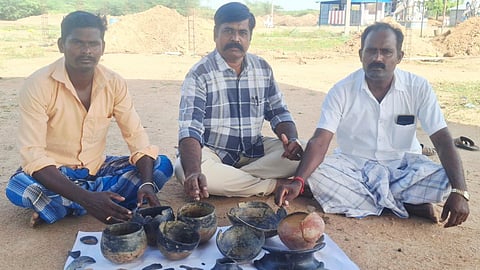
Acting on information from residents Mari and Velmurugan of Perungarunai, V Rajaguru, president of the Ramanathapuram Archaeological Research Foundation, inspected the site and said burial urns were distributed across nearly three acres around the temple. “One of the urns exposed during the digging contained three goblets, a plate, a bowl, a kumbha and a small pot. The assemblage comprises black-and-red ware and red ware, ceramic traditions closely associated with the megalithic cultural horizon,” he added.
Rajaguru said that the site had also yielded terracotta stands and lid fragments bearing incised symbols. Three red-ware sherds and seven black-and-red ware sherds carried motifs resembling a multiplication sign, an inverted trident and a ladder. Similar remains had surfaced in 2018 during the excavation of a pond south of the temple, suggesting that the archaeological deposit extends beyond the present discovery.
Explaining the funerary tradition, Rajaguru said, “During the early megalithic phase, communities first exposed the dead outside settlements before collecting the skeletal remains for secondary burial. The bones, accompanied by personal belongings and ritual offerings, were placed inside urns, sealed and interred. The practice later evolved into primary urn burials, in which the entire body was buried.”
He noted that the black-and-red pottery displays a polished surface produced through controlled firing techniques, including the application of salt to achieve a glazed finish. Based on the typology of the urns and associated ceramics, the assemblage could date to around 5,000 years ago.
Nearly 500 metres north of the burial field, at Raja Kovil Thidal in Vikramapandiyapuram, pottery fragments are scattered across nearly 30 acres, indicating the presence of an ancient habitation. The evidence suggests that Vikramapandiyapuram functioned as a settlement, while Valasai and Manakkulam served as its burial complex.
Rajaguru urged the Tamil Nadu State Department of Archaeology to undertake systematic excavations. “The site has the potential to provide fresh insights into settlement patterns, funerary practices and the cultural sequence of the early megalithic period in southern Tamil Nadu,” he pointed out.