
- Chennai
- Tamil Nadu
- India
- World
- EntertainmentEntertainment
- Business
- Sports
- Lifestyle
- Technology
- Videos
- Explainers
- Editor's Picks

CHENNAI: People in low and middle income countries who cannot afford ACs, heat resilient housing or quality healthcare will bear the brunt of climate change, with India emerging as one of the countries facing a significant rise in temperature-related deaths by 2050, according to a new US based Climate Impact Lab (CIL) report.
Titled ‘Adaptation Roadmap: Human Health’ the report projects that by 2050, the world’s poorest populations will experience the largest increase in heat related mortality despite contributing the least to global greenhouse gas emissions.
It has warned that while wealthier countries could offset rising temperatures through adaptation, millions in India would remain highly vulnerable because of limited access to cooling, making investments in heat adaptation an urgent public health priority. Climate change will widen global health inequalities, with low and middle income countries expected to suffer the highest number of temperature-related deaths as millions of people remain unable to afford basic cooling facilities.
It attributes the disparity not only to rising temperatures but also to lower incomes, weaker healthcare systems, poor housing conditions and limited access to adaptation measures.
India, classified by the World Bank as a lower middle income country, is among the nations identified as facing significant climate related health risks. While India is not expected to record the highest mortality rate per 100,000 people globally, its vast population means that even moderate increases in mortality could translate into tens of thousands of additional deaths every year.
The report says today’s poorest populations were projected to suffer the most from a warming climate because they often lack access to AC, insulated homes, reliable electricity and quality healthcare. These were measures that wealthier populations increasingly rely on to reduce the health impacts of extreme heat.
Researchers observed that adaptation was not only about installing ACs. It also included improving access to cooling centres, expanding green spaces, strengthening public health systems, designing heat resilient cities, introducing early warning systems and ensuring that vulnerable communities received timely support during prolonged heatwaves. However, they emphasised that access to household cooling remained one of the most immediate life saving interventions, particularly in countries where extreme heat was becoming more frequent.
Across Asia, India is among the countries expected to witness increasing temperature related mortality. The study identified Hyderabad, Delhi, Mumbai and Kolkata as among 95 Asian cities projected to experience an increase of at least 10 temperature related deaths per 100,000 people by 2050, with rapid urbanisation, dense populations and the urban heat island effect expected to amplify the health risks in these areas.
The report noted that South Asia, along with Northern Africa and the Middle East, would remain one of the world’s climate mortality hotspots. Pakistan was projected to experience the largest increase in temperature related mortality in the region, but India’s population size made it one of the countries where adaptation measures could save the greatest number of lives.
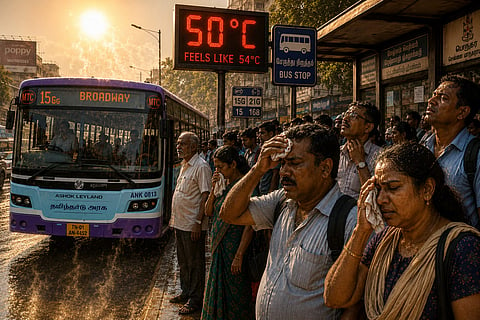
The findings come at a time when India continued to witness increasingly intense and prolonged heatwaves. Several states have recorded temperatures above 45 degrees Celsius, with outdoor workers, construction labourers, street vendors, farmers and daily wage earners among those facing the highest risks because they spend long hours outdoors and often have limited-to-no access to cooling.
“Governments must invest in targeted adaptation programmes that prioritise vulnerable populations, particularly in low and middle income countries where public resources remain limited,” the report suggested. “Such measures include heat action plans, expanding tree cover, climate resilient housing, improving electricity access and strengthening emergency medical response during extreme heat events.”
Kurian Joseph, environmental engineer and former Anna University professor, said, “Rising heat exposure poses a serious risk to public health, particularly for children, senior citizens, pregnant women, persons with disabilities, migrant labourers, outdoor workers, and other vulnerable groups.”
The TN strategy, which led to the formation of a Heat Action Network under the Tamil Nadu State Planning Commission, combines immediate measures with long-term interventions to strengthen the state’s resilience to heat. “It focuses on 3 key systems: natural ecosystems, vulnerable livelihoods, and the built-in environment to reduce the impacts of extreme heat. Priority must be health and well-being, sustained resource and economic productivity, and cooling solutions,” he added.
For India, where extreme heat was becoming an increasingly frequent public health emergency, the report concluded that reducing climate-related deaths would depend not only on global efforts to curb emissions but also on ensuring that affordable cooling, resilient infrastructure and accessible healthcare reach the country’s most vulnerable communities. Without such investments, the burden of climate change was likely to fall disproportionately on those least able to protect themselves.