
- Chennai
- Tamil Nadu
- India
- World
- EntertainmentEntertainment
- Business
- Sports
- Lifestyle
- Technology
- Videos
- Explainers
- Editor's Picks

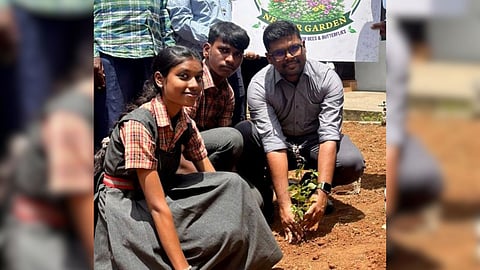
COIMBATORE: In a pioneering initiative, the forest department has begun developing a dedicated pollinator garden featuring exclusively native flowering plants at the Coimbatore Forest Division office campus.
Spread across 3,000 sq ft, the garden has been designed to attract bees, butterflies and other pollinating insects while promoting the regeneration of indigenous plant species and strengthening urban biodiversity.
Launching the initiative on Monday, District Forest Officer (DFO) N Vengatesh Prabhu said that many ornamental flowering plants commonly found in parks are exotic species that flower only for a short period before withering.
“Native flowering plants, on the other hand, are better adapted to local climatic conditions, survive for several years and provide a sustained source of nectar and habitat for pollinating insects," he said.
The garden currently houses around 1,200 plants representing 18 native species. Forest officials and conservationists plan to gradually expand the collection to 100 species over the next six months, although sourcing many of the indigenous plants remains a challenge as several are endemic and occur only in the wild.
According to R Vinny Peter, Secretary of the Centre for Urban Biodiversity Conservation and Education (CUBE), the project is the culmination of nearly a year of research to identify native flowering plants that are beneficial to pollinators.
"While Lantana camara is an invasive alien species, we also have a native lantana that is non-proliferative and does not adversely affect the ecosystem. This garden will also enable us to study the diversity of insects attracted to different native plant species," she said.
The garden includes a range of indigenous flowering plants such as white leadwort, green shrimp plant, golden eye grass and the native non-invasive lantana, each selected for its ability to support local pollinator populations.
Beyond the pilot project, conservationists have proposed establishing similar native pollinator gardens in vacant urban spaces, educational institutions, corporate campuses and other suitable locations. The long-term objective is to create a network of pollinator habitats that function as ecological corridors, allowing bees, butterflies and other beneficial insects to move more freely across urban landscapes and enhancing biodiversity in cities.
Ajay Gupta, a conservationist associated with the initiative, said expanding the diversity of native flowering plants remains the project's immediate priority. "Our goal is to increase the number of native flowering plant species from 18 to 100 within the next six months. Identifying and sourcing these plants is challenging because many are endemic and found only in natural habitats," he said.