
- Chennai
- Tamil Nadu
- India
- World
- EntertainmentEntertainment
- Business
- Sports
- Lifestyle
- Technology
- Videos
- Explainers
- Editor's Picks

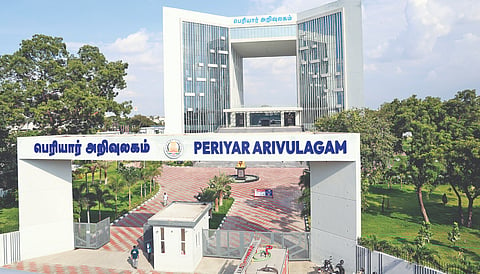
CHENNAI: A process that normally takes six months was reportedly wrapped up in 30 days, and thousands of questionable titles, including AI-generated books and works attributed to fictitious authors, ended up in Tamil Nadu's public libraries. The unusually short timeline for buying books for the Coimbatore Periyar Arivulagam and six other district libraries has raised questions over whether established procedures were bypassed.
The controversy has widened, with inspections over the past week identifying 70,674 suspect books worth an estimated Rs 7 crore across public libraries in the State. The exercise is continuing, and the number could rise.
The School Education Department had ordered books for five Arivulagams in Coimbatore, Tiruchy, Salem, Cuddalore and Tirunelveli, besides six newly established district libraries in Tenkasi, Ranipet, Tiruppattur, Kancheepuram, Kallakurichi and Mayiladuthurai. Around Rs 190 crore was allocated.
A government order issued on November 5, 2025, constituted four committees to oversee the process: Book Recommendation, Book Selection, Book Procurement Negotiation and High-Level Committee. The recommendation committee had 137 members, including writers, academicians, senior journalists and book critics. Of them, 112 attended the meeting held on January 9, 2026.
Sources familiar with the process said the recommendation exercise alone would normally take three to four months, followed by scrutiny of the suggested titles, price negotiations with publishers and writers, and final approval by the High-Level Committee. The entire exercise was expected to take at least six months. Completion of procurement within a month has therefore raised suspicions.
Speaking to DT Next, publisher and Kizhakku Pathippagam founder Badri Seshadri suspected that questionable titles could have been inserted at the final approval stage rather than during the initial recommendation process.
He said the larger recommendation committee was unlikely to have facilitated such manipulation and pointed to the five-member High-Level Committee as a possible point of intervention. He urged the Directorate of Vigilance and Anti-Corruption (DVAC) to identify those responsible.
The digital procurement system is now under scrutiny. A comparison of the original recommendations with the final approved catalogue, along with portal login records, upload histories and modification timestamps, could establish whether titles were added after the committees completed their scrutiny.
The Madurai Bench of the Madras High Court, in its November 11 order, recorded that Agalvilakku was paid Rs 17 lakh for 1,700 titles, while Kizhakku Pathippagam received an order worth only Rs 23,000. It also noted that three bank accounts containing about Rs 22 lakh had been frozen.
The High Court has directed the DVAC to register an FIR and sought complete procurement records, details of the entities involved and the number of suspect books distributed across libraries by November 16.