
- Chennai
- Tamil Nadu
- India
- World
- EntertainmentEntertainment
- Business
- Sports
- Lifestyle
- Technology
- Videos
- Explainers
- Editor's Picks

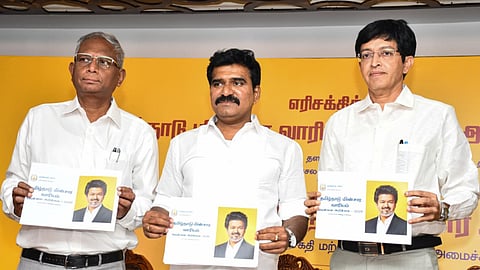
CHENNAI: Energy Resources Minister R Nirmalkumar on Thursday released a White Paper on the Tamil Nadu Electricity Board (TNEB), blaming the previous DMK government for the utility's deteriorating financial and operational health and alleging that inadequate investment in power distribution infrastructure and negligible recruitment had weakened the electricity network despite a sharp increase in revenue and borrowings.
The government simultaneously unveiled a Rs 49,532-crore investment plan for the next five years to modernise the utility.
Releasing the White Paper, minister R Nirmalkumar said the document analysed TNEB's financial and operational performance over the last 25 years and sought to explain how the utility accumulated mounting debt while infrastructure creation and manpower additions lagged behind growing electricity demand.
According to the document, TNEB's revenue increased significantly during the 2021-26 period following tariff revisions, generating more than Rs 65,000 crore in additional income. However, expenditure also rose by around Rs 51,000 crore, leaving only a marginal reduction in the revenue-expenditure gap.
The minister questioned the sharp increase in spending, saying it had not translated into expansion of substations, transformers, transmission infrastructure or manpower.
The government claimed that TNEB borrowed nearly Rs 87,400 crore during the previous five-year period, the highest among all the five-year periods reviewed. Despite the record borrowings, only 122 substations were commissioned against 359 in 2016-21, and just 343 employees were recruited during the period (compared with 9,800 in 2016-21), the White Paper said.
Nirmalkumar added that the State continues to face a shortage of more than 400 substations, while delays in providing electricity connections, meters, and maintenance services have become common due to inadequate infrastructure and staff.
The minister identified manpower shortage as one of the utility's biggest challenges. TNEB currently requires around 1.40 lakh employees but has only about 74,700 personnel on its rolls, leaving nearly 66,000 vacancies. More than 20,800 employees retired during the last decade, and another 16,782 are expected to retire over the next five years.
He alleged that the previous government recruited only 343 personnel despite rising revenues and borrowings, forcing existing employees to shoulder multiple responsibilities and affecting fault restoration, transformer replacement and consumer services.
To address the shortage, the government announced plans to recruit 15,000 employees this year. It also said that appointments for 5,391 gangmen, whose recruitment has been pending since 2021, would be completed, bringing the total recruitment this year to 20,449.
The White Paper also highlights the ageing condition of the electricity network.
According to the data presented, only 122 new substations were commissioned during the period despite substantial increases in revenue and borrowings.
He said transformer installations had increased in number, but the government would separately analyse procurement costs and expenditure connected with such purchases.
According to the government, 184 of the existing 33 kV substations are more than 25 years old, while nearly half of the 110 kV substations have crossed their design life. About 42,000 of the State's 4.47 lakh distribution transformers are over 25 years old and another 50,000 have crossed 20 years, contributing to equipment failures and voltage fluctuations.
On the power procurement front, the minister said Tamil Nadu's peak demand has reached around 21,307 MW, while TNEB's own thermal, hydro and gas stations generate only about 3,500 MW. The State continues to depend heavily on purchases from private generators, the central pool and interstate sources. He said costly short-term purchases through power exchanges would gradually be replaced with long-term power purchase agreements, which are expected to save about Rs 215 crore every month.
As part of the revival programme, the government has drawn up a Rs 49,532-crore infrastructure investment plan for the next five years. During 2026-27 alone, projects worth Rs 21,512 crore will be launched, including the construction of 231 substations, the installation of 60,000 distribution transformers and the procurement of around 21.7 lakh electricity meters. Another Rs 8,318 crore has been earmarked for the renovation and upgrading of ageing substations.