
- Chennai
- Election-2026Election-2026
- Tamil Nadu
- National
- World
- Cinema
- Business
- Sports
- Lifestyle
- Technology
- Videos
- Explainers
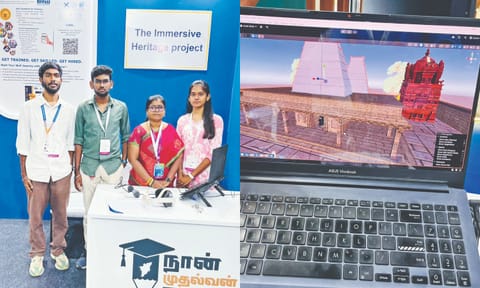
CHENNAI: A team of young researchers who trained under the Naan Mudhalvan scheme has developed a prototype titled ‘The Immersive Heritage Project’, aimed at enabling tourists, pilgrims, senior citizens, and persons with disabilities to virtually explore India’s iconic temples and monuments through cutting-edge Virtual Reality (VR) technology.
The innovative project was conceptualised and guided by Professor P Revathy, with researchers SKM Kavyashree and B Harini, alongside students DK Charan Raj and PG Adithya from the BE Computer Science and Engineering (CSE) and Design departments of Rajalakshmi Engineering College.
The team’s pioneering idea seeks to recreate the experience of visiting ancient temples and heritage monuments in an interactive, real-time VR environment, providing a lifelike view of sacred and historical sites, especially beneficial to those who are unable to visit in person due to age, illness, or physical limitations.
Explaining the motivation behind the initiative, Professor Revathy said, “We designed this project to help foreign visitors, elderly people, and those with mobility issues who struggle to navigate crowded spaces during festivals or weekends. This VR-based model will offer them a realistic and spiritual experience of visiting their aspirational temples, deities, and monuments. If installed at strategic locations such as hill temples, airports, government offices, or panchayat centres, it could greatly benefit the public.”
Sharing her insights, researcher Kavyashree said, “We have developed this as a prototype. To bring it to full scale, we require detailed structural designs, authentic photographs, and high-resolution videos of significant temples like the Madurai Meenakshi Amman temple, Palani Murugan temple, and other heritage sites across Tamil Nadu. We’re seeking necessary permissions, funding, and an advanced workspace equipped with modern technologies to enhance the model further.”
Another team member, Charan Raj, added, “We’ve already showcased this project at a startup festival, and we’re presenting it here as well. Our next step is to approach the State government for official permissions and funding. Once approved, we want to fully develop this system and make it accessible for public use.”