
- Chennai
- Tamil Nadu
- India
- World
- EntertainmentEntertainment
- Business
- Sports
- Lifestyle
- Technology
- Videos
- Explainers
- Editor's Picks

“Vegetables are cultivated across around 17,300 acres in the Nilgiris. Due to lack of rainfall, the area under cultivation has declined by nearly 40 per cent. For instance, garlic, which was cultivated across around 700 acres, is now grown in only about 425 acres. Compared to the bountiful yield recorded last year, vegetable yields have also declined by around 20 per cent this year due to water shortage. Nearly 70 per cent of the population in the Nilgiris depends on farming for livelihood,” said K Kannamani, Deputy Director of Agricultural Marketing and Agri Business, The Nilgiris.
The rainfall deficit has not only discouraged farmers from taking up fresh cultivation but has also affected crop development. P Maragathamani, Joint Director of Horticulture, Nilgiris, said the district received just 283 mm of rainfall in 2026, against the normal 874 mm. During the corresponding monsoon period last year, the district had received 1,038 mm.
“This year, rains were recorded only for about a week in June, followed by a prolonged dry spell throughout the southwest monsoon, which normally extends from June 10 to August 20,” she said.
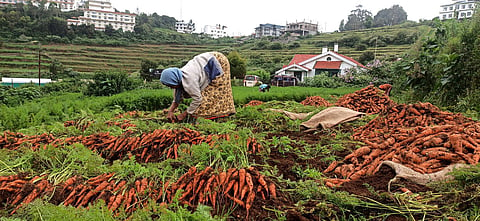
The failure of the monsoon has severely affected both the area under cultivation and yields of major hill vegetable crops. “ Potato growers, in particular, have reported poor tuber formation due to inadequate soil moisture. Garlic yield has declined from around four tonnes to two tonnes per acre, potato from eight tonnes to three tonnes, beetroot from 15 tonnes to eight tonnes, cabbage from 35 tonnes to 20 tonnes per acre, while carrot yield has also fallen drastically,” said Maragathamani.
Besides lack of rains, the farmers have also had to contend with higher temperatures in recent months, further stressing crops.
“Temperatures have risen in recent months, affecting cultivation. Even some of the recent downpours came in the form of cloudbursts, which can be more destructive as they cause erosion of fertile topsoil. Vegetable growers in the district, who normally produce around 18 to 20 tonnes of hill vegetables a month, have been managing with just 10 to 12 tonnes in recent months. A combination of water scarcity, rising temperatures and erratic rainfall took a heavy toll on crops,” said A Ganeshan Arunasalam, vice-president of the Nilgiris Organic Horticulture Farmers Association (TOHFA).
Unlike farmers in the plains, vegetable growers in the hills have limited alternatives when rainfall fails. They depend heavily on rain-fed cultivation, while restrictions on digging wells and drilling borewells make it difficult to develop reliable alternative sources of irrigation.
The crisis is affecting around 36,000 small and marginal vegetable growers in the Nilgiris. The district is known for producing a wide range of traditional hill vegetables, including carrot, beetroot, radish, cabbage, chow-chow and garlic. Farmers also cultivate high-value exotic vegetables such as lettuce, iceberg lettuce, Chinese cabbage, broccoli, zucchini, Brussels sprouts and leek.
A substantial portion of the exotic vegetable produce is supplied to markets across south India. With production now significantly below normal, farmers are facing a double blow — lower yields and farm incomes on one hand, and sharply rising cultivation and market prices on the other.
The reduced supply has already pushed vegetable prices higher in retail markets, raising concerns that the prolonged production shortfall could further tighten supplies and keep prices elevated in the regional markets.