
Chennai
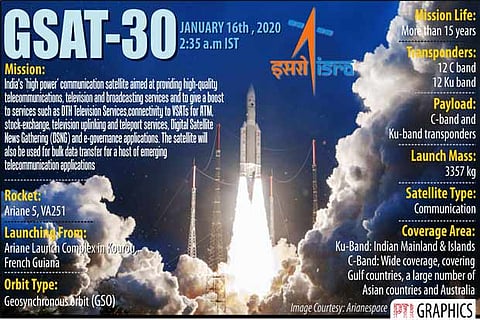
The launch vehicle Ariane 5 VA-251 lifted off as scheduled from Kourou Launch Base, French Guiana at 02.35 am carrying India’s GSAT-30 and EUTELSAT KONNECT for Eutelsat.
After a flight lasting 38 minutes 25 seconds, GSAT-30 separated from the Ariane-5 upper stage in an elliptical Geosynchronous Transfer Orbit. With a lift-off mass of 3,357 kg, GSAT-30 will provide continuity to operational services on some of the in-orbit satellites. GSAT-30 derives its heritage from ISRO’s earlier INSAT/GSAT satellite series and will replace INSAT-4A in orbit.
“GSAT-30 has a unique configuration of providing flexible frequency segments and flexible coverage. The satellite will provide communication services to Indian mainland and islands through Ku-band and wide coverage covering Gulf countries, a large number of Asian countries and Australia through C-band,” ISRO Chairman Dr K Sivan said.
Dr Sivan also said that “GSAT-30 will provide DTH Television Services, connectivity to VSATs for ATM, Stock-exchange, Television uplinking and Teleport Services, Digital Satellite News Gathering (DSNG) and e-governance applications. The satellite will also be used for bulk data transfer for a host of emerging telecommunication applications.”
ISRO’s Master Control Facility (MCF) at Hassan in Karnataka took over the command and control of GSAT-30 immediately after its separation from the launch vehicle. Preliminary health checks of the satellite revealed its normal health.
In the days ahead, orbit-raising manoeuvres will be performed to place the satellite in Geostationary Orbit (36,000 km above the equator) by using its on-board propulsion system.
During the final stages of its orbit raising operations, the two solar arrays and the antenna reflectors of GSAT-30 will be deployed. Following this, the satellite will be put in its final orbital configuration. The satellite will be operational after the successful completion of all in-orbit tests.
Visit news.dtnext.in to explore our interactive epaper!
Download the DT Next app for more exciting features!
Click here for iOS
Click here for Android