
- Chennai
- Tamil Nadu
- India
- World
- EntertainmentEntertainment
- Business
- Sports
- Lifestyle
- Technology
- Videos
- Explainers
- Editor's Picks

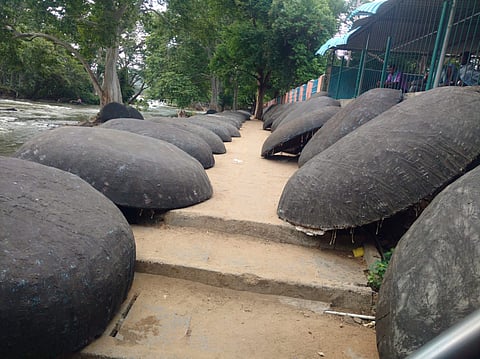
COIMBATORE: A parched Cauvery due to a prolonged dry spell has transformed Hogenakkal's roaring waterfalls into exposed rock beds, leaving hundreds of coracle operators struggling without work.
The famous waterfalls, which usually draw thousands of visitors from Tamil Nadu and neighbouring States, now present a starkly different picture. Large stretches of exposed rocks have replaced the gushing waters as only a trickle flows through.
"Only during weekends is the tourist turnout moderate. On weekdays, the footfall is abysmally low," said K Rajendran, a coracle operator and member of the Centre of Indian Trade Unions (CITU).
"Such a prolonged dry spell is unprecedented. Over the last few years, we have had good inflows. Currently, around 50 to 70 coracle rides are operated on weekdays, and approximately 900 rides are conducted on weekends. During the peak tourist season in May, it would be above 1,300 rides. Business started declining from June itself because of the lack of water," he said.
Coracle services continue to operate only in isolated stagnant pools of water, but operators say the experience no longer offers the scenic appeal that tourists expect.
"There is hardly anything to see except exposed rocks. The waterfalls, which offer a spectacular sight during good flow, now carry only minimal water," Rajendran said.
For many of the 432 licensed coracle operators, the downturn has become a livelihood crisis.
V Amsaraj (40), who has been rowing coracles at Hogenakkal for the past 22 years, fears the situation could worsen if rainfall remains scarce. "A similar dry spell occurred in 2015. Even the bathing area now receives only a trickle of water," he said.
The contrast with last year could not be sharper. By the middle of June 2025, heavy releases from Karnataka had swollen the Cauvery, forcing authorities to suspend coracle operations for nearly two months as a safety measure. This year, however, the river has receded dramatically, exposing vast stretches of the riverbed.
Ironically, the receding waters have revealed a hidden attraction. The Jaganmohini Cave, which remains submerged for most of the year, has resurfaced in the Cauvery stretch. Believed to have been carved into a rock face for the shooting of the Tamil film Jaganmohini in 1978, the cave has become an unexpected draw for visitors. Coracle operators have begun ferrying tourists to the site, allowing them to explore the cave.
A coracle ride covering the 2.5-km stretch between Mamarathu Kadavu and Manalmedu on the Karnataka border costs Rs 1,500 for a family of four. Of this, Rs 200 is collected by the administration, while the remaining amount goes to the coracle operators.
Despite the cave attracting curious visitors, operators say it has done little to offset the overall decline in business.
The economic impact extends well beyond the coracle operators. Several hundreds of families in Hogenakkal depend directly or indirectly on tourism for their livelihood, including masseurs, women engaged in cooking for visitors, roadside vendors and shopkeepers.
With the southwest monsoon yet to significantly replenish the Cauvery, the tourism stakeholders say their hopes now rest on sustained rainfall in the river's catchment areas to restore both the waterfalls and their livelihoods.