
- Chennai
- Tamil Nadu
- India
- World
- EntertainmentEntertainment
- Business
- Sports
- Lifestyle
- Technology
- Videos
- Explainers
- Editor's Picks

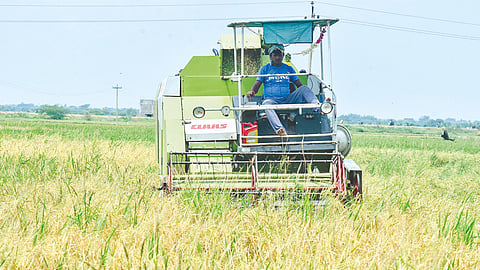
TIRUCHY: Even as the district administrations in the Cauvery Delta region have initiated steps to organise tripartite meetings to regulate rental rates for paddy harvesters, farmers have expressed strong dissatisfaction over the failed monitoring mechanism, alleging that they are forced to pay an exorbitant amount. However, the owners blame middlemen for facilitating rates higher than those agreed upon in the meetings.
With samba and thalady harvest already commenced across the Delta region and likely to peak in a couple of weeks, farmers have been consistently raising concerns over the availability of harvester machines and seeking regulation of rental rates.
After several appeals from the farmer associations, the respective district administrations across the region convened tripartite meetings, involving progressive farmers, leaders of farmers associations, agricultural officials, including agricultural engineering department staff, private harvester owners and agents in January to fix the rentals for harvester machines. Accordingly, the rent was fixed at Rs 2,600 per hour for belt machines and Rs 1,850 per hour for tyre-type machines. For the belt-type machines owned by the agricultural engineering department, the rate was fixed at Rs 1,880 per hour, and for the tyre-type ones, it was Rs 1,160 per hour.
"As samba, thalady harvest in Thanjavur, Tiruvarur, Mayiladuthurai and Nagapattinam commenced around the same time, the demand for harvest machines surged. As there are only around 30 harvester machines available in the agricultural engineering department, the role of private players has become inevitable. The availability of often two to three private harvester machines per revenue village has significantly increased the farmer dependence on private players," Sami Natarajan, general secretary, Tamil Nadu Vivasayigal Sangam affiliated with CPM, told DT Next.
Natarajan noted that private players working in collusion with middlemen are charging between Rs 2,900 and 3,200 per hour against the actual rents fixed in the meetings. “Despite the tripartite meeting being held on time and rent being fixed after consultation with the stakeholders, there is no mechanism to monitor the charges collected by the private players," Natrajan further said.
Pointing out that the government provides a diesel subsidy for the agricultural engineering department, Cauvery V Dhanapalan, the general secretary of the Cauvery Farmers Protection Association, noted the department can operate the machines for as low as Rs 1,160. In the absence of such a subsidy for the private players, they need to collect a possibly higher amount, he noted.
“Owing to the rising demand for harvest machinery, the state government actively provided loans and subsidies to the farmers for the procurement of harvester machines, and thus, the number of private harvester machines increased recently. However, instead of the owners, the middlemen fix the amount to make a profit for themselves," he said.
Dhanapalan further said that as the machines are being operated from 11 am to 5 pm, the farmers have to spend money accordingly. "However, the private operators can't be blamed because they have no other option but to depend on the middlemen to pay EMI for their machines, and idle machinery is a major risk that can lead to losses for them. So, the middlemen collect at least Rs 200 more per hour and, on average, make at least Rs 1,000 per day. This should be properly monitored," he said.
Advocating for the machine owners, he noted that they might not earn more profit, as they have to provide wages to drivers and helpers from the rental amount.
Dhanapalan, who also owns a harvester machine, appealed that the rent should be increased in line with the fuel prices.