
Coimbatore
More than seven months have passed by since the Erode manjal (turmeric) was bestowed with the Geographical Indication (GI) tag. However, the tag that certifies a product to be unique with regard to its place of origin, has failed to bring cheer to turmeric cultivators in the district who rue that the demand for their indigenous variety crop is yet to pick up in both the domestic and international markets.
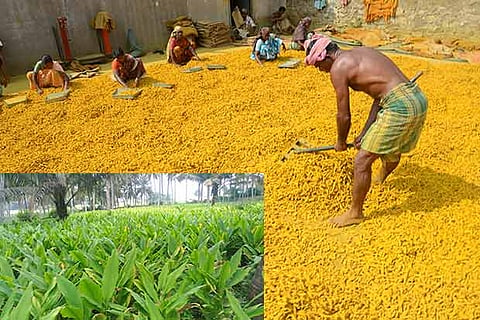
The Geographical Indications Registry granted the GI tag to Erode turmeric in March this year. Widely cultivated in the Kodumudi, Sivagiri, Bhavani, Gobichettipalayam, Anthiyur, Chennampatti, Sathyamangalam and Thalavady regions in Erode district, besides in parts of Coimbatore and Tirupur districts, there are two main varieties of turmeric, namely the Chinna Nadan and Perum Nadan. Farmers in Erode, however, are known to raise only the Chinna Nadan variety, which is known for its colour, aroma, yield and disease tolerance. While the figure for turmeric farmers in the entire State is pegged at 55,000, around 30,000 are into the crop’s cultivation in Erode alone.
With just months for the harvest season to commence, and the GI tag expected to have boosted prospects of the turmeric farmers in Erode, they, however, have a sorry tale to tell. “The GI tag hasn’t made any difference to Erode turmeric in both the domestic and international markets. Belying our expectations, the demand for our turmeric with unique qualities has not grown a bit. It didn’t fetch better pricing for farmers,” said PK Deivasigamani, the president of Turmeric Farmers Association of India.
Explaining the reason behind the poor demand for turmeric despite the GI tag, Deivasigamani said, “The US and European countries prefer only organically-grown items. But organic cultivation is yet to catch up with the turmeric farmers in our region. So, the GI tag hasn’t brought about any change in the mindset of importers to go for Indian turmeric. Our utmost demand now is to ban chemical fertilizers and further, turmeric farmers should turn organic for exports to increase.”
Lack of efforts by both the State and Central governments to market turmeric in the international market is also blamed for the poor demand. Export of the yellow spice for the past 15 years has been constantly hovering over 78,000 and 80,000 tonnes per annum. “The governments don’t show interest in marketing turmeric as much as in increasing its production. They don’t create opportunities for cultivators to increase exports and to explore newer markets. Though the demand for turmeric is increasing, the exports haven’t increased a bit due to lack of support from the government,” said S Boopathi Sundaram, a farmer from Erode district.
Farmers in Erode also say that a drop in turmeric price is inevitable this season due to surplus production in Telangana and Maharashtra from good rains there. “For the second consecutive year, there were copious rains in the western region. Yet, only traditional farmers have gone for turmeric cultivation as the agro-climatic conditions in Erode were only best suited for raising this crop,” said Deivasigamani.
With the harvest season of turmeric set to commence in January, farmers also lament that they are staring at poor pricing for their produce. They also state to have been demanding the State and Central governments to fix minimum support price (MSP) for turmeric, but it seems to have fallen in deaf ears.
With multiple factors such as these making them to suffer severe losses, a large number of turmeric farmers felt to have no option but to switch over to other crops like maize, sugarcane and groundnuts. The number of turmeric farmers in the State, that once stood at around a lakh and has been on a sharp downslide since, only seems to tell a tale.
LACKLUSTRE TURMERIC CITY
Visit news.dtnext.in to explore our interactive epaper!
Download the DT Next app for more exciting features!
Click here for iOS
Click here for Android