
- Chennai
- Tamil Nadu
- India
- World
- EntertainmentEntertainment
- Business
- Sports
- Lifestyle
- Technology
- Videos
- Explainers
- Editor's Picks
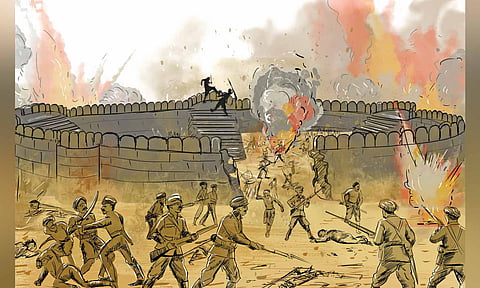
CHENNAI: Historians who chronicle India’s fight against the British usually present the 1857 rebellion across the land, as the first war of Independence. Out of these historians, those in the South, more so from Tamil Nadu, map the rebellion in the Vellore Fort by sepoys and supporters of Tippu, in 1806 as the first fight against the British.
A few other scholars who research on the freedom struggle, trace the first rebellion to the activities of poligars like Poolithevar of Nell Kattumsevel and Veerapandia Kattabomman of Panchalankurichchy, and his brother Oomaithurai and his friends, the Marudu brothers.
Though records do not conclusively reveal the last days of Poolithevar, it is certain that he was vanquished by the forces of the British. In the case of Kattabomman, Oomaithurai and Marudu brothers, there are well enshrined records chronicling their final days and deaths.
On their campaigns and movement of forces, and courses of conflicts against their native enemies, like Kattabomman, Pulithevan Marudu brothers and Velu Nachiar, the British have left elaborate and detailed records, diaries and dispatches.
These rebels hailed from Old Tinneveli and Ramnad districts. Curiously, it is from these areas that militant freedom fighters like the revolutionary poet Subramanya Bharathy, VO Chidambaram Pillai, who steered the native steam ship rivalling the British navigation company, and Veera Vanchi, who shot dead Collector Ashe of Tirunelveli district emerged. Tirunelveli and Ramanathapuram can be considered equal to Punjab and Bengal in the freedom struggle.
Around the time of Kattabomman rebellion, ordinary people around Kamuthi, Kadalgudi, Mudukulathur, and Abiramam in Ramanathapuram revolted against the British establishment. This is a fact, though recorded in the official annals, has not been adequately driven home, in the history text books.
In April 1768, tashildar’s office at Kamuthi was ransacked, guards injured and their weapons stolen, and prisoners liberated. Similar attacks were launched in the government offices at Mudhukulathur, and it did not need much intelligence for the officials of East India Company to decipher that these attacks were made by supporters of Sethupathy of Ramnad whose territories were usurped by the company illegally.
The company officials fixed Meelappan, a commandant of Sethupathy of Ramanathapuram, to be the instigator of these attacks. In fact, the rioters’ success in Kamuthi, Mudhukulathur and Abiramam encouraged many to join and swell the ranks of rebels who perpetrated similar attacks in different places in the district. The poligar of Kadalgudi sent more than 100 such rebels to attack Mudhukulathur.
Vijayareghunada Sethupathy, who succeeded Kilavan Sethupathy, divided his fiefdom into 72 parts and built forts in Kamuthi, Aranthangi Rajasinghamangalam, Thirupathur, Oriyur and Pamban. The fort built in Kamuthi, designed by French engineers, was located on the banks of the River Gundar. This was taken over by the East India Company after the Nawab of Arcot had handed over Ramanathapuram to the East India Company.
The fort had been a place of action during the days of Kattabomman and Oomaithurai. It was attacked by Sivaganga forces of Marudu brothers in 1801 and was used as the training and camping ground for their forces.
But the company wrested it from them. It is said when the Collector of Tinnevely desired Kattabomman to meet him in Ramanathapuram, he was reported to have stayed for a while in the fort. The fort, which had strong fortifications, was reported to have been partly washed away by the floods in Gundar, otherwise called Vijaya Sethupathy Cauvery. The remnant fort now houses Kamuthi Special force raised by the British as Punitive Force after Kamuthi rioting in 1918.
The Kamuthi Special Force was raised in the aftermath of a rioting when 50 invading rioters were shot dead by a petty party of one head constable and 15 constables trying to quell 5,000 strong looters gathered on a shandy day — September 17, 1918. They set fire to shops in shandy and bazaar inflicting an economic loss of Rs 50,000 to traders.
Two constables were killed by the rioters and the distraught head constable wired his headquarters in Madurai for reinforcement. The government rushed reinforcements and decreed the cost of maintenance of the police so augmented after rioting to be paid by the citizens of Kamuthi besides imposing a fine for rioting.
This subsequently got revoked when Raja of Ramnad and prominent members of Nadars affirmed to the government peace and tranquillity among the communities in Kamuthi area. The precinct of the dilapidated fort is turned alive by housing the quarters of Kamuthi Special Police Force, and an impressive temple worshipped by men and families of the force.
— The writer is a former DGP, Tamil Nadu
