
- Chennai
- Tamil Nadu
- India
- World
- EntertainmentEntertainment
- Business
- Sports
- Lifestyle
- Technology
- Videos
- Explainers
- Editor's Picks

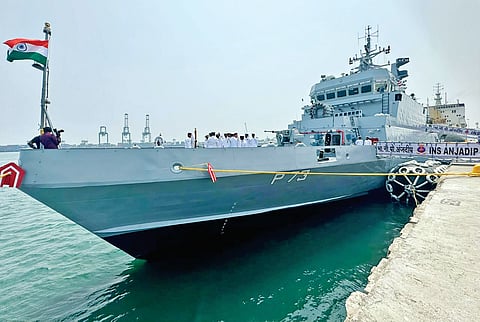
CHENNAI: The Indian Navy on Friday commissioned INS Anjadip, the fourth indigenously designed and built Anti-Submarine Warfare Shallow Water Craft (ASW-SWC), boosting its coastal defence.
The Chief of the Naval Staff, Admiral Dinesh K Tripathi, commissioned the warship at Chennai Port. Part of a 16-ship ASW shallow water craft programme, the vessel is designed to enhance anti-submarine and coastal surveillance operations in shallow sea areas near the coastline, particularly along the eastern seaboard under the Eastern Naval Command.
Measuring 77.6 metres in length and displacing about 1,400 tonnes, INS Anjadip, which is also called 'Dolphin Hunter', can attain speeds of up to 25 knots. The ship is powered by a diesel water-jet propulsion system that provides high manoeuvrability and relatively quieter operations.
The vessel carries shallow-water sonar, torpedoes, and anti-submarine rockets, as well as a remotely operated naval gun. Integrated combat and platform management systems link its sensors and weapons, while a torpedo decoy system offers protection during engagements.
Built by Garden Reach Shipbuilders - Engineers (GRSE), a defence PSU under the Ministry of Defence, with construction carried out at L&T's Kattupalli shipyard. Officials noted that the ship incorporates over 80% indigenous components, including major weapons and sensor systems.
INS Anjadip revives the name of the earlier Petya-class corvette that served the Navy from 1972 to 2003. The name traces its origins to Anjadip Island off the Karnataka coast, associated with naval action during the 1961 liberation of Goa.
The commissioning comes amid heightened focus on maritime security in the Indian Ocean Region (IOR), through which nearly 1,20,000 ships transit annually, carrying about two-thirds of global oil shipments and half of container traffic. Since October 2023, Indian naval deployments in the Red Sea have enabled the safe transit of nearly 400 merchant vessels carrying around 16.5 million metric tonnes of cargo valued at over $7 billion.
The induction is part of a broader expansion drive. In 2025, the Navy commissioned 12 warships and one submarine, and plans to induct around 15 more vessels in 2026. With 50 ships currently on order at Indian shipyards, the service has outlined a long-term objective of evolving into a 200-plus ship fleet by 2035, with a particular focus on strengthening anti-submarine and under-sea combat capabilities.
IN-HOUSE WARSHIP
Designed for anti-submarine operations in coastal and near-shore waters
Incorporates over 80% indigenous parts
Carries shallow-water sonar for submarine detection
Armed with lightweight torpedoes and anti-submarine rockets
Equipped with a remotely operated naval gun
Integrated combat and platform management systems to link sensors and weapons
Fitted with a torpedo decoy system for defence