
Chennai
While cryptocurrency is gaining wider acceptance globally, it has lost its currency in India for all the wrong reasons. An inter-ministerial committee has recommended a complete ban on virtual currencies. The panel recommended a ban on mining, holding, sales, purchase and dealing in virtual currencies. If these recommendations are implemented, cryptos will be illegal in India and violation will attract a jail term of up to 10 years.
A committee headed by Finance Secretary Subhash Chandra Garg has proposed a draft Bill, ‘Banning of Cryptocurrency & Regulation of Official Digital Currency Bill 2019’, which makes holding of cryptocurrencies a non-bailable offence.
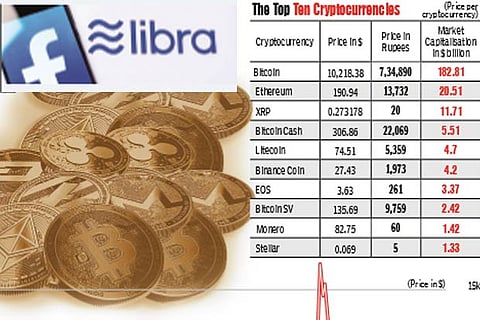
It all started when the Bitcoin (see box story for details), the first cryptocurrency which was launched in 2009 for practically nothing, skyrocketed to $ 19,783.06 (Rs 14,20 236 at current exchange rate) on Dec 17, 2017, and made global headlines. Bitcoin moved to the coin exchange on March 17, 2010 when its price was just $0.003, (22 paise). Today, the crypto market is booming with over 1,600 different digital currencies and its market capitalisation is over $ 260 billion (Rs 18.2 lakh crore) now. The market is dominated by the pioneer Bitcoin with a market capitalisation of $ 185 billion (Rs 12.95 lakh crore) followed by Ethereun, XRP, Bitcoin Cash and Litecoin (Refer graph: Top Cryptocurrencies)
There is confusion in the Indian crypto scene. While the government has clarified in the Rajya Sabha in July 2019 that the country has not put any blanket ban on cryptocurrencies, the Reserve Bank of India (RBI), India’s central bank, placed restrictions on banks dealing with cryptos. This has been challenged in the apex court and the hearings are going on.
Former finance minister, Arun Jaitley, in his 2018 Budget speech categorically said that the government does not consider cryptocurrencies as legal tender. A seasoned trader who doesn’t want to be named said the government position is “on the border”. At present, one cannot do any legal transactions easily using crypto coins in India.
The National Association of Software and Service Companies (Nasscom) has opposed the proposal to ban cryptocurrencies saying it will cripple the development of new technologies that would discourage India’s thriving start-up culture. It said, “Instead [of banning], the government should work towards developing a risk-based framework to regulate and monitor cryptocurrencies and tokens”.
There are hundreds of start-up companies in India which engage in developing products and services based on blockchain technology on which cryptocurrencies work. They have protested the move saying that the ban prevented them from advancing the technology to the next level.
Swetank Shantanu, a leading Supreme Court lawyer, said, “In the present form, the proposed Bill is a clear violation of Article 19 (1) (g), which gives citizens freedom to practice any profession or to carry on any occupation, trade or business”. Creating a proper digital infrastructure with a proper e-surveillance mechanism is important to create a fool-proof system to allow the virtual currencies to float, he said.
Governments across the world are worried because cryptos are attractive for lawbreakers who can hold and transfer the virtual money without a central authority. So, the transaction is not traceable. It is widely used by terrorists and underworld for their terror and illegal activities.
Did the proposed ban and the RBI restrictions halt crypto trading in India? Most of the crypto exchanges have closed down, but an unofficial thriving market developed in many cities, especially in Gujarat. Sources say the new unofficial market, a type of business-to- business market, has developed where the price is static, killing the dynamics of the live exchange.
In Chennai, according to dealer Shiva, there are only two or three official transactions per day. It is done through escrow accounts, and dealers charge a high fee of 1.5 to 2 per cent for purchase as well as sales. Another dealer who doesn’t want to be identified said one can transact Bitcoin or any other cryptos in Chennai. “You have to create a (Bitcoin) wallet account or we will create it for you. You can pay through banks or cash. We will help you transact,” he said. It is totally an unofficial market and the dealer will help you in everything. This unofficial market is getting currency in India. Bitcoin trading is said to be thriving in Coimbatore and Tiruchi as well.
Another development is that it is moving towards hawala (illegal transactions). Sources say politicians, film stars and the underworld have all invested in cryptocurrencies. Japan, one of the first countries to legalise cryptos, has a vibrant legal system to regulate its smooth functioning. China has banned it. In June 2019, China’s central bank-People’s Bank of China-said it would “block access to all domestic and foreign cryptocurrency exchanges and ICO websites”. After the ban, operations shifted from the mainland to Hong Kong and London. Now a booming unofficial market thrives in China.
China has had a rethink and has already announced its plans to come out with its official cryptocurrency soon.
Social media giant Facebook, with 2.41 billion monthly active users, is planning to come out with its own cryptocurrency christened as Libra in 2020. Libra is designed not to be a speculative asset, like Bitcoin, but of digital money backed by a reserve of assets. At present, no one knows how it will shape up. If it works, the market expects that it will change the dynamics of the global crypto market.
US President Donald Trump tweeted recently: “I am not a big fan of Bitcoin and other cryptocurrencies, which are not money, and whose value is highly volatile and based on thin air. Unregulated crypto assets can facilitate unlawful behavior, including drug trade and other illegal activities…”
According to a New York Times report, Islamic terrorists are increasingly using Bitcoin for raising funds to finance their terror activities. In recent months, government authorities and organisations have begun to raise alarms about an uptick in the number of Islamist terrorist organisations experimenting with Bitcoin and other digital coins. Several troubled regimes like Iran, Venezuela and Russia, which are under US sanctions, are in the process of having their own cryptocurrencies to circumvent the sanctions.
All major countries accepted the ‘global coin’ and it is widely accepted across all major e-commerce platforms and other leading business establishments. European central banks are divided on the issue. The US central bank, Federal Reserve, has no intention. Critics say the new digital money is a reactionary product that has the potential to destroy the global monetary system and termed underlying technology blockchain as a “glorified excel spreadsheet”. However, crypto enthusiasts believe that it is the most democratised and revolutionary money in human history and has the potential to end the hegemony of the US dollar in the global
economy.
Bitcoins comE of age in digital world
ALL ABOUT BITCOIN
Visit news.dtnext.in to explore our interactive epaper!
Download the DT Next app for more exciting features!
Click here for iOS
Click here for Android