
- Chennai
- Tamil Nadu
- India
- World
- EntertainmentEntertainment
- Business
- Sports
- Lifestyle
- Technology
- Videos
- Explainers
- Editor's Picks

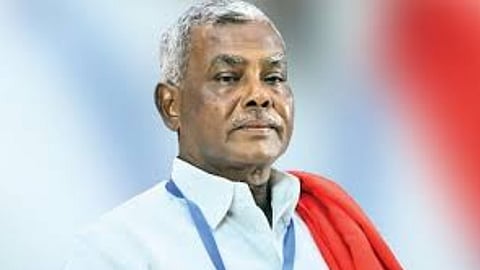
CHENNAI: Defending the Left parties' decision to extend outside support to the TVK government, CPM state secretary P Shanmugam launched a sharp attack, claiming that their decision had blocked an illegitimate effort of Dravidian majors to usurp power against the people's wish and mandate. He criticised the 'naked opportunism' of the Dravidian parties.
He said the move was necessary to prevent President's Rule in the State and honour the people's verdict for political change beyond the traditional DMK-AIADMK binary.
Writing about the sequence of events that led to the Left parties supporting the TVK government in the party mouthpiece Theekathir, Shanmugam hit back at criticism from what he called DMK supporters and pro-DMK commentators who questioned the CPM's decision to support the government led by Chief Minister C Joseph Vijay despite contesting the Assembly election as part of the DMK-led alliance.
Arguing that the post-election arithmetic left little room for alternatives, Shanmugam said the party examined three possible scenarios: supporting TVK, backing an AIADMK government with DMK support, or paving the way for President's Rule and possibly fresh elections.
"The first responsibility was to prevent President's Rule," he said, alleging that such an outcome would have effectively placed the State under the control of the BJP-led Union government through the Governor.
Shanmugam maintained that TVK, which emerged as the single largest party with 108 seats, had a legitimate claim to form the government despite falling short of a majority. The CPM leader said the election verdict reflected a public desire for an alternative to both the DMK and AIADMK.
Rejecting suggestions that the DMK should have supported an AIADMK-led administration, Shanmugam described the proposal as "blatant opportunism". He argued that the electorate had decisively rejected the BJP-AIADMK alliance and that installing a defeated coalition in power would have amounted to disregarding the mandate.
"What else can one call it but naked opportunism if a defeated alliance is installed in power? For this reason, the CPM rejected the proposal of forming a government with the support of the AIADMK-DMK combine," he said. He noted that those supporting the DMK themselves maintained that the AIADMK could not even be considered a Dravidian party by their own standards.
The CPM leader also sought to explain TVK's electoral success, saying the party had successfully tapped into public dissatisfaction with the previous DMK government. While acknowledging that TVK and Vijay lacked prior administrative experience, Shanmugam dismissed criticism centred on the Chief Minister's background in film. Drawing parallels with former chief ministers MG Ramachandran and NT Rama Rao, he said similar doubts had been raised when they entered politics but were ultimately rejected by voters.
Shanmugam said TVK had assured the Left parties that it would uphold secular values, run an inclusive administration and provide clean governance. He also signalled the CPM's intention to monitor the new government's economic policies closely. According to him, the administration would be judged on issues such as employment generation, wage security, corruption control, reduction of economic inequality and fulfilment of election promises.
Calling the Assembly election a turning point in Tamil Nadu politics, Shanmugam said the dominance of the DMK-AIADMK duopoly had suffered a setback after more than five decades, creating a new political landscape in the State.