
- Chennai
- Tamil Nadu
- India
- World
- EntertainmentEntertainment
- Business
- Sports
- Lifestyle
- Technology
- Videos
- Explainers
- Editor's Picks

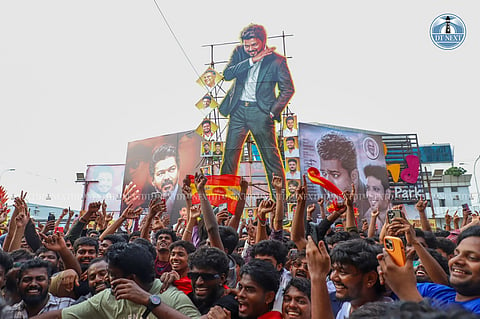
For more than three years, film buffs in Tamil Nadu have missed out on one of the biggest celebrations surrounding a major star’s film release: early morning shows. The practice came to a halt in January 2023, while theatres in neighbouring states continued screening films in the early hours.
This prompted fans from Tamil Nadu to travel across State borders to catch the first-day-first-show (FDFS) of their favourite stars. The absence of early shows also affected producers and exhibitors, as reviews and reactions from neighbouring states began circulating on social media even before the first show commenced in Tamil Nadu, potentially influencing audience expectations and opening-day collections.
That is why the decision by Chief Minister C Joseph Vijay-led government to permit 6 am screenings and up to six shows a day during the first seven days of a film's release is a special gift from the actor-turned-politician to the film fraternity, that too right in time for Deepavali.
This has brought major relief to the industry, particularly for Suriya's ‘Scene’, Nayanthara-starrer ‘Mookuthi Amman 2’, and mega-budget project ‘Ramayana’, featuring Ranbir Kapoor, Yash and Sai Pallavi.
Outside a Chennai theatre screening Suriya’s ‘Scene’, movie buff Kudiyarasu, who had previously travelled to neighbouring states to catch the FDFS of his favourite stars’ films, welcomed the return of early morning shows. “We used to travel long distances, mostly to Nagari, and even miss a day’s work just to watch the FDFS. But the theatres near the border areas are not always up to the mark. While the celebrations were there, the experience could never match watching a film alongside fellow fans in our own city, Chennai. The return of 6 am shows is a huge relief, as I can now enjoy the first-day-first-show experience in my own city,” he said.
Dr G Dhananjayan, treasurer of the Tamil Film Active Producers Council, said the early morning screenings had received an encouraging response, particularly for ‘Scene’, which reportedly had around 400-500 shows across Tamil Nadu. “The film released simultaneously across the world, allowing audiences here to experience it at the same time as moviegoers elsewhere. From a business perspective, all the shows together generate approximately Rs 10 crore a day. Over seven days, that could translate into additional revenue of around Rs 70 crore. Apart from producers, the resulting GST and other tax collections will also benefit the government,” he said.
Speaking about the government’s response to the film industry’s requests, Dhananjayan said, “The present TVK government has been responsive to the industry’s concerns. Recently, Rs 15.68 crore in long-pending film subsidies for 224 films, which had remained unpaid for seven years, was released. The permission for 6 am shows is another positive step. Our current request is for the removal of the 4% local body entertainment tax; we hope the government will review the matter and arrive at a favourable decision.”
Sakthivelan B of Sakthi Film Factory, which is distributing ‘Scene’, said the early morning screenings had benefited not just fans but also working professionals who often find it difficult to watch films during regular show timings.
“‘Scene’ received a tremendous response for its 6 am shows, and it feels good that the film has released simultaneously across all centres. One important aspect is that working-class audiences who wish to watch a film often find it difficult to get time during their work schedules. With 6 am screenings, they can watch the film before heading to work, making it more convenient for them. This is a welcome move for movie lovers,” he said.
Appreciating the government’s decision, he added, “The Chief Minister and ministers understand the issues and requests raised by the film industry.”
The decision has brought cheer to the entire film exhibition industry, with theatre owners describing it as a timely 'Deepavali gift'. The move addresses a long-pending demand of the industry, according to the Tamil Nadu Theatre and Multiplex Owners Association.
Association president Tirupur Subramaniam pointed out that films being released early in neighbouring states had consequences beyond audience convenience, particularly in an era when social media and digital platforms can influence a film's prospects even before its first screening in the State.
"When screenings commenced at 9 am in Tamil Nadu, audiences across other southern states were completing their shows by 8.15 am to 8.30 am," Subramaniam said. In today's fast-paced digital media environment, public reviews and box-office verdict reach audiences before the first show even begins in Tamil Nadu, dampening viewer enthusiasm and severely impacting the opening collections of film producers, he added.
"We placed these operational difficulties before the Chief Minister (C Joseph Vijay), who immediately issued orders allowing early morning 6 am screenings," said Subramaniam.
The association also expects the decision to translate into higher revenue for the government. Highlighting the economic implications, Subramaniam said increasing the daily screening limit from the earlier four-to-five shows to six could raise commercial entertainment tax receipts by an estimated 20 per cent.
Subramaniam added that digital monitoring of ticket sales and revenue operations by the State government would ensure that the additional business generated through the extended screenings is accounted for, without revenue leakage.
Beyond the change in screening timings, the industry is also seeking an overhaul of the regulatory framework governing cinema theatres in the State. Subramaniam disclosed that joint industry bodies had urged the government to revisit outdated provisions under the Tamil Nadu Cinemas (Regulation) Act of 1952, which have remained in place for more than seven decades.
"None of our pending demands entail any revenue loss to the government. The administration has assured us that after Deepavali, existing outdated laws will be re-examined and aligned with modern requirements. With regulatory relaxation, we anticipate that the number of functional movie screens in Tamil Nadu could double from the current 1,200 by 2026-27, creating vital theatrical space for both big-budget productions and small-scale films," he said.