
- Chennai
- Tamil Nadu
- India
- World
- EntertainmentEntertainment
- Business
- Sports
- Lifestyle
- Technology
- Videos
- Explainers
- Editor's Picks

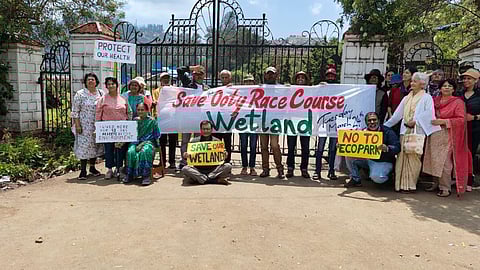
COIMBATORE: Environmental activists staged a protest on Tuesday opposing proposed development activities at the historic Ooty Race Course, describing it as a vital high-altitude wetland and one of the last remaining lung spaces in the Nilgiris district.
They raised concerns over plans by the government to establish an eco-park and by the municipal administration to construct a multi-level parking facility within the premises.
Surjit K Chaudhary, chairperson of the Confederation of Environment Associations of Nilgiris (CEAN), emphasised the ecological importance of the sprawling Race Course grounds. He noted that the area plays a crucial role in groundwater recharge, flood regulation, and maintaining ecological balance in the hill town.
“Any large-scale development in this fragile ecosystem could have serious environmental consequences,” he warned.
Chaudhary highlighted multiple alleged violations linked to the proposed projects. He pointed out that construction within 100 metres of the racecourse would contravene the Hill Station Building Rules, 1993. He further stated that mandatory clearances from the Hill Area Conservation Authority (HACA), as well as approvals under the Environment Protection Act, 1986 and Wetland Rules, had not been obtained.
Describing the Race Course as a natural sponge that absorbs and regulates storm water, he cautioned that its degradation could increase the risk of flooding in the region. He urged authorities to designate the area as a protected wetland and transfer its management to the Forest Department, drawing parallels with the conservation model of Pallikaranai Marsh in Chennai.
Protesters also called on authorities to demolish structures allegedly built in violation of regulations by the Madras Race Club within the racecourse premises. Additionally, they demanded urgent measures to prevent sewage from flowing into Ooty Lake and nearby wetlands.
Activists stressed that ecological preservation must take precedence over infrastructure expansion, particularly in environmentally sensitive hill regions like the Nilgiris. The Race Course, which has hosted horse racing events for over a century, was leased to the Madras Race Club. However, controversy emerged after the club allegedly defaulted on lease payments amounting to Rs 822 crore since 1978.
Following legal proceedings, the Madras High Court directed the government to reclaim the land. After taking possession, the state government proposed developing the area into an eco-park, plans that have now sparked strong opposition from environmental groups.