
- Chennai
- Tamil Nadu
- India
- World
- EntertainmentEntertainment
- Business
- Sports
- Lifestyle
- Technology
- Videos
- Explainers
- Editor's Picks

CHENNAI: Teaching children with disabilities, even in a special school, requires a nuanced approach that goes beyond gadgets and technology. While regular students, for instance, learn 85% with their sight, for the visually impaired, other senses play a crucial role.
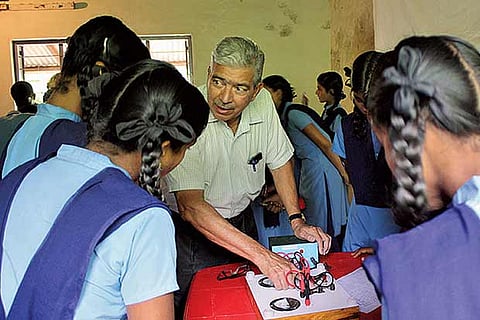
“For teaching a visually impaired child, you should be ready to explain everything,” says KRB Saravanamanikandan, a Tamil teacher in Government HS School for Visually Impaired, Trunk Road in Poonamallee. “If you teach an ordinary student about an apple, you can draw a picture and explain the parts of the fruit. But with a child who cannot see, you have to bring a real apple, cut it and give it to the child for tasting,” he explains.
There is no special syllabus to teach blind children. All special schools follow the Samacheer Kalvi syllabus prescribed under the Tamil Nadu State Board of School Education. “But it is in a touch-and-talk medium and we begin with teaching Braille,” he says.
Since last year, the State government has ensured that textbooks in Braille script are available in special schools. “Despite a delay in delivery, these books have been helpful. The previous government designed an accessible website (new.tnschools.gov.in) that contains textbooks for all subjects in all formats (PDF, EPUB, HTML) and can be read online too,” states the Tamil teacher.
The teacher-student ratio in special schools is 1:8 compared to 1:40 in other schools. And, teachers are not given extra time for their syllabus or teaching.
Teachers in such special schools believe that, slowly, the need for special schools would vanish if the government took adequate steps to integrate and be more inclusive. “All the special schools are under the control of the Department for the Welfare of the Differently Abled. This mainly focuses on the rehabilitation of the disabled persons and hardly on special schools. That’s why we’ve been asking for a long time to bring special schools under the School Education Department,” says Saravanamanikandan