
- Chennai
- Tamil Nadu
- India
- World
- EntertainmentEntertainment
- Business
- Sports
- Lifestyle
- Technology
- Videos
- Explainers
- Editor's Picks

CHENNAI: Nearly 30 per cent of Madurai city's present urban footprint lies over lost and encroached waterbodies, according to a newly launched water monitoring dashboard by civic data platform Neervazhvu, which has flagged growing concerns over groundwater depletion, shrinking water infrastructure and the city's long-term drinking water security.
The dashboard, launched recently, compiles publicly available government and environmental data related to Madurai's water infrastructure, reservoir dependency, groundwater conditions and urban waterbody losses. The platform presents district-specific indicators, including the status of the Vaigai reservoir, dependence on Mullaiperiyar water diversion, Madurai Municipal Corporation (MMC) supply infrastructure, groundwater stress by block and CPCB-monitored Vaigai river water quality.
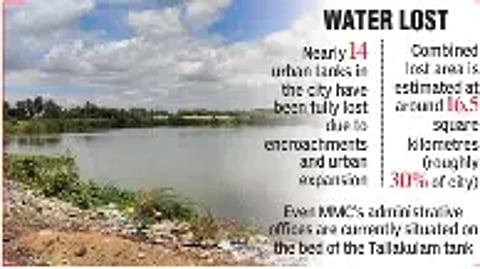
A key finding highlighted by the dashboard is the extent of urban waterbody loss within the Madurai city limits. According to Neervazhvu data, nearly 14 urban tanks in the city have been fully lost due to encroachments and urban expansion. The combined lost area is estimated at around 16.5 square kilometres, which the platform says accounts for nearly 30 per cent of Madurai city's footprint.
Even MMC's administrative offices are currently situated on the bed of the historic Tallakulam tank, one of the fully encroached waterbodies identified in the study, the report noted.
The study notes that the State has already spent approximately Rs 84.12 crore on the Vaigai Riverfront beautification project, which is said to be 98 per cent complete.
However, a separate proposal worth Rs 440 crore aimed at improving river ecology and sewage infrastructure, including pumping stations and river cleanup measures, has reportedly been awaiting Tamil Nadu government sanction since 2024.
The dashboard further draws attention to groundwater stress in several blocks surrounding Madurai city and attempts to map areas vulnerable to future water scarcity.
Another major issue flagged by the study is the delay in implementing a Madras High Court directive on waterbody transparency. In March 2024, the Madurai Bench of the Madras High Court directed the State to publish a public registry of waterbodies within six months. According to Neervazhvu, nearly 20 months after the deadline, no compliant public database has been made available by the state government.
Madurai-based environmental activist Ravindran told DT Next that nearly 180 waterbodies created during the Pandya period for the city's drinking water and agriculture needs have now been encroached upon.
He alleged that several supply canals carrying water from the Vaigai river to different parts of the region have also been completely encroached and claimed that many government buildings constructed in Madurai during the 1980s and 1990s were built on encroached waterbodies.
Ravindran also pointed to the destruction of natural grasslands that once stretched from Avaniyapuram in Madurai to Aruppukottai, which he said played a major role in groundwater recharge.
According to him, the government later converted large portions of these grasslands for SIPCOT and other industrial projects, leading to a decline in groundwater levels across the region.
He also alleged that the available groundwater now contains high levels of heavy metals because untreated sewage is let into the Vaigai, which pollutes groundwater and makes it non-potable
Ravindran warned that Madurai, the third-largest city in Tamil Nadu with a population of nearly 15 lakh people, could face a severe drinking water crisis in the future if the city continues to depend heavily on groundwater as its primary water source.