
- Chennai
- Tamil Nadu
- India
- World
- EntertainmentEntertainment
- Business
- Sports
- Lifestyle
- Technology
- Videos
- Explainers
- Editor's Picks
OSLO: Anemone Kulczak, the chief arbiter at Norway Chess, has been a constant presence since the tournament's early days in 2013 -- quietly observing its evolution, its innovations, and the shifting fortunes that have marked every edition.
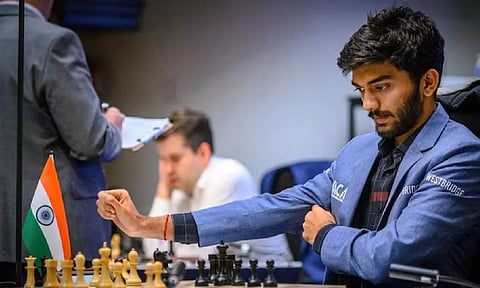
A seasoned French arbiter with years of experience overseeing hundreds of elite clashes carries the authority that comes from long exposure to top-level chess events, and she is rarely quick to overstate conclusions. Even so, in her view, reigning world champion D Gukesh remains the clear favourite to defend his crown later this year.
"Javokhir Sindarov also has experience but as a world champion, you know, Gukesh has more experience, I would say. So, yes, for me he has more experience but the world championship games are really interesting to follow," says Kulczak, a mother of a young daughter who works in a biology lab in Nice, speaking in a strong French accent with a measured tone.
Gukesh will take on Kazakhstan's Sindarov later this year to defend his title, with critics pointing to a dip in form since his 2024 world title triumph and suggesting he has not looked quite the same player. Meanwhile, Sindarov is being tipped as a potential dark horse in the championship showdown.
Kulczak, who has been part of Norway Chess through most of its modern history apart from a brief break when her four-year-old daughter was born, has witnessed its full evolution -- from the era of five-time world champion Viswanathan Anand to Magnus Carlsen's rise as a seven-time Norway Chess winner, and the introduction of women's chess, along with the challenges of the COVID pandemic.
She has also been the arbiter in moments that went viral, including when Carlsen banged the table in Stavanger after a loss to Gukesh in a round-robin game last year.
When asked in a lighter vein if Carlsen or any other player had ever caused her problems over the years, she says, "It was me who was watching the Armageddon tie-break when he (Carlsen) played against Gukesh... and when he knocked the table.
"It was the last game to finish that day so he was not disturbing anyone when he did it so as an arbiter I did not say anything but had some more games been ongoing on other boards I would have told him please do not do this again because you are disturbing other players," says Kulczak.
On whether officiating a superstar like Carlsen brings added pressure, Kulczak is unequivocal. For an arbiter, she says, the rules matter more than reputations, especially under the glare of cameras and constant media scrutiny.
Arbiters, she explains, are constantly multitasking -- monitoring the games, ensuring the live broadcast matches, the moves on the board, keeping the playing hall free of distractions and stepping in whenever players need clarification.
The pressure only intensifies in time trouble, when every second counts.
"When players have less than five minutes, they can stop writing the moves," she says.
"Then we have to make sure the opponent continues to record them
In a tournament where fortunes can swing on a single move, even the smallest detail can become an arbiter's responsibility, she adds.
She still fondly remembers the inaugural edition of Norway Chess in 2013, when Anand was among the participants. Mentioning the Indian great brings a smile to her face as she says, "I guess I remember that I arbitrated him."
Kulczak, who was also an arbiter at the 2014 Chess Olympiad in Norway, began officiating at just 18 and earned her International Arbiter title six years later, says the COVID pandemic was among the most challenging periods in the tournament's history.
"I was here during COVID and we all had to arrive before the tournament because of quarantine rules," she recalls.
"After every game, we had to clean and sanitise all the pieces. Every table had to be sprayed with disinfectant. It was meticulous, very meticulous."
Kulczak is full of praise for the Indian contingent, saying players such as Praggnanandhaa, Gukesh, Divya Deshmukh and Koneru Humpy are an arbiter's delight because they consistently follow the rules.
"Yes, it's easier to arbiter them," she says with a smile.
As for Carlsen's longevity and whether he can surpass Garry Kasparov's record of spending 20 years as the world No. 1 in classical chess, Kulczak believes the answer lies largely with the Norwegian himself.
"I think it depends more on his spirit. If he wants to, I'm sure he's capable of doing what Garry Kasparov did," she signs off.
