
- Chennai
- Tamil Nadu
- India
- World
- EntertainmentEntertainment
- Business
- Sports
- Lifestyle
- Technology
- Videos
- Explainers
- Editor's Picks

CHENNAI: Cricket has always worn its gentlemanly reputation with pride. But behind the traditional whites, and the much-celebrated spirit of the game lies a history that isn’t quite as clean. From deliberately targeting batters with bouncers to fixing matches for money, cricket has witnessed some extraordinary breaches of trust. With Sandpapergate back in the spotlight, here is a look at the incidents that tested the game's conscience.
Cricket’s first major controversy, aka the Bodyline. One that perhaps even shaped the safety regulations of the sport. During England’s 1932-33 Ashes tour to Australia, England captain Douglas Jardine had devised a specific plan to tackle the best batter at that time, Sir Don Bradman. The plan was simple: short, high-speed deliveries aimed at the batter’s body while placing multiple fielders deep on the leg side boundary.
With no helmets around at that time or body-armours which would prevent nasty injuries, several Australians were on the receiving end of the damage, including captain Bill Woodfull and wicketkeeper Bert Oldfield, who suffered a fractured skull.
The controversy took off in the third Test of the Ashes, when a ball hit Woodfull on his chest, right over the heart and he collapsed to the ground holding his chest. Later in the day, one of England’s managers, Pelham Warner visited the Australian dressing room, to which Woodfull replied, “There are two teams out there, one is trying to play cricket, and the other is not.”
As a direct consequence of the tour, MCC introduced a new rule to the Laws of Cricket, where it hoped that captains would ensure that the game was played in the correct spirit, and passed a resolution that bodyline bowling would breach this spirit. In 1957, the laws were altered to prevent more than two fielders in the square leg region.
With six runs needed to tie the match, and eight wickets down, the then Australian captain Greg Chappell instructed his younger brother, Trevor to bowl an underarm delivery to prevent Brian McKechnie, New Zealand’s No 10 from hitting a maximum. The irony of it was that back then, the underarm rule was in the ‘grey zone’ of international cricket, which means it was legal but wasn’t ethical.
As McKechnie blocked the ball, the right-hander threw his bat up in the air in disgust, and despite the then New Zealand skipper Geoff Howarth pleading, the decision wasn’t going to be overturned. It paved the way for ICC to change the rules, as underarm bowling was banned.
In the first of many high-profile ball tampering cases was English captain, Michael Atherton. Back in 1994, at the iconic Lord’s, Atherton was accused of ball-tampering during the Test series against South Africa. During that time frame, there was nothing more embarrassing than ball-tampering in the world of cricket.
Lord's, the home of cricket, was hardly the place one would expect to find an England captain caught with dirt in his pocket. Yet that was precisely where a 25-year-old Michael Atherton found himself in 1994, when television cameras captured him reaching into his pocket and rubbing the ball with a substance, which he later said was to dry his hands.
As it turned out, he was accused of lying, and was fined heavily – 2000 pounds back in 1994 – for failing to disclose the dirt to the match referee, by Ray Illingworth, England’s then Chairman of Selectors.
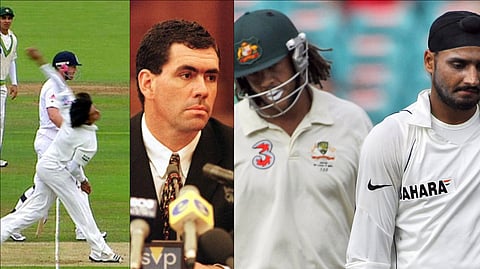
Hansie Cronje had embodied South African cricket’s revival. But now, he’s the most recognised sporting figure at the centre of a scandal that threatened to destroy the game’s credibility. On April 7, 2000 when Delhi police crime branch officer Ishwar Singh Redhu revealed a recording between Cronje and Sanjay Chawla, a representative of the betting syndicate, little did anyone expect that it would make cricket ugly.
While Cronje denied it at first, he later admitted accepting between $10,000 to $15,000 from a London-based bookmaker for 'forecasting' results, and not fixing. Cronje revealed that former India captain Mohammad Azharuddin had introduced him to bookmaker Mukesh Kumar Gupta during South Africa's 1996 tour of India. Azharuddin himself was later named in the CBI's match-fixing report, which alleged his involvement in fixing matches. The BCCI subsequently imposed a life ban on him in December 2000, before it was overturned in 2012.
Having received money from bookmaker Marlon Aronstam, Cronje helped turn what appeared certain to be a draw into a contest that England eventually won. The South African all-rounder received 53,000 rands (30,000 and 20,000 rands), and a leather jacket as a gift for providing insider information.
Following his confession, Cronje was banned from cricket for life, bringing a stunning end to his international career. In June 2002, he died in a plane crash aged 32.
Sachin Tendulkar wasn’t just another cricketer. For 1.03 billion people, he was god, and match referee, Mike Denness, a satan. 25 years ago, in 2001, during India’s tour to South Africa, Tendulkar was spotted on the camera removing a piece of grass from the ball – and cleaning it, without informing the umpire.
Denness had later stated that Sachin was penalized for not informing the umpire, and handed him a suspended one-Test ban and fined him 75% of his match fee. The Board of Control for Cricket in India (BCCI) launched a strong protest and demanded Denness’ removal from the third Test, and when the match went on without a referee, it was deemed unofficial, and didn’t count as a Test. It turned into a diplomatic war, and exposed the growing tensions between India’s cricketing authorities and the ICC.
Pakistan’s share of controversy in world cricket began long before The Oval Test against England but this encounter went down in history – the first and only forfeit in cricket’s history. On August 20, 2006, an hour before the tea on the fourth day, at the end of 56th over of England’s second innings, umpires Darrell Hair and Billy Doctrove asked for a change of ball. Everything seems normal until then? And then the umpires proceeded to award England five penalty runs.
It kicked off an ugly war, as Pakistan skipper Inzamam-ul-Haq and his boys refused to take the field in response to ‘ball-tampering allegations’. The two umpires had declared that England won the match, and not abandoned or aborted. With no real evidence, ICC dropped the charges on Inzamam, but received a four-match ban for bringing the game into disrepute. But the match was awarded to England, later in 2009.
2008: India and Australia wrote the ugliest chapter in its rivalry, aka the ‘Monkeygate’. Till date, it stands as one of the most talked about series in cricketing history due to all the poor decisions and calls that were taken against India. But on day three of the Sydney Test in 2008, the series became uglier after Indian all-rounder Harbhajan Singh’s Hindi insult towards Andrew Symonds had turned into a racial slur.
As per many reports, the off-spinner had used a similar sounding Hindi insult, which Symonds had misheard as ‘Monkey’, with match referee Mike Procter handing Harbhajan a three-match ban. The BCCI had threatened to pull out of the series, alleging that Harbhajan was dealt harshly.
New Zealand High Court judge John Hansen conducted a formal hearing where Tendulkar’s testimony played a crucial role, with the Indian revealing that it was an ‘offensive Hindi phrase’, after which the charge was downgraded from racial abuse to just offensive language.
In terms of modern-day cricketing controversies, Mohammad Amir’s spot-fixing scandal ranks amongst the top ones. In August 2010, player agent Mazhar Majeed was caught by undercover reporters of the British newspaper, News of the World, as accepting £150,000 to arrange pre-planned no-balls during the match.
The players in focus: Amir and Mohammad Asif. Later on, replays of the no ball also were clear enough to suggest that Amir and Asif both had deliberately overstepped. ICC’s tribunal found them guilty of corruption (spot-fixing), with Pakistan skipper Salman Butt receiving a hefty ten-year ban (five of which were suspended), Asif seven years (two suspended) and the youngest of them all, Amir a five-year suspension.
Amir later made an international return but the black mark never went away.
Two years before Sandpapergate rocked the cricketing world, there was the South African captain Faf du Plessis who was found guilty of ball-tampering after having applied saliva containing mint residue to shine the cricket ball in the Hobart Test. On November 18, 2016, the ICC charged him with ball-tampering under Law 42.3, for using an artificial substance/saliva with mint to alter the ball’s condition.
However, he wasn’t banned, as the South African captain was fined 100% of his match fees and was handed three demerit points. It wasn’t the first time that Faf du Plessis was fined for altering the ball. Back in 2013, du Plessis was fined by the ICC for rubbing the ball on trouser zipper in the Test against Pakistan.
Eight years on, Sandpapergate remains a stain on Australian cricket, with questions about how much the team knew and who was involved continuing to divide opinion. For a sport that prides itself on fair play, perhaps the most damaging part of the scandal was the suggestion that the problem went beyond three individuals.
Cameron Bancroft was caught on camera using sandpaper to shine the ball, which led to a 12-month ban from Cricket Australia (CA) for captain and vice-captain, Steve Smith and David Warner.
While Warner endured a lifetime captaincy ban, Smith has since then skippered the country, and even led to the duo missing out the 2018 edition of Indian Premier League. Darren Lehmann, who coached the Australian team too stepped down after the incident, while Tim Paine was appointed as the new captain of the Australian team in a ‘cultural rebuild’.
It has resurfaced in the limelight after Usman Khawaja’s book, Sabr, which claims that every member on the touring party knew of the plan – use of sandpaper to alter the ball – and make it reverse swing. Warner, Bancroft and the 12th man for that Test, Chadd Sayers all went on to back Khawaja’s claims, which was then disputed by skipper Pat Cummins in a 70-minute long press conference where he hit out at Khawaja’s claims.