
- Chennai
- Tamil Nadu
- India
- World
- EntertainmentEntertainment
- Business
- Sports
- Lifestyle
- Technology
- Videos
- Explainers
- Editor's Picks

CHENNAI: Modern cricket hardly gives its stars space to breathe. For two years, Ishan Kishan lived under constant public scrutiny, sometimes for his social media feed, sometimes for his personality after the BCCI stripped him of his central contract.
Yet, minutes after wrapping up a marathon 270 that spanned almost two full days, there was no swanky press conference. Instead, the 28-year-old quietly asked reporters to join him on the turf, speaking while sitting on the outfield, reflecting his state of mind.
“I think the best thing I'm doing nowadays is not thinking about anything,” Kishan said after the second day’s play in the Duleep Trophy.
“As a batter, my job is to watch the ball and react to it. I don’t set any expectations for myself, and keep things extremely simple. Living in the present, playing ball-by-ball has helped me. Obviously, you will lose patience, and you will have thoughts on what you could do differently. But you have to control it, and execute your plans.”
Two years ago, when Kishan suffered the biggest setback of his career, he chose the oldest currency in Indian cricket: sheer domestic volume and runs.
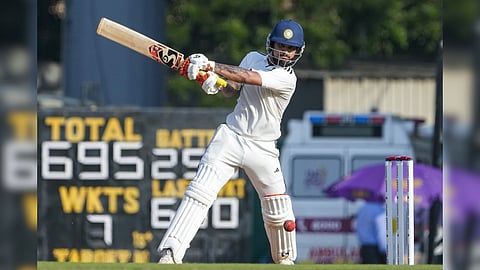
He captained Jharkhand through an unbeaten Syed Mushtaq Ali Trophy campaign, topping the tournament charts with 517 runs, anchored by a blistering 49-ball century against Haryana. At Chepauk, leading a stacked East Zone unit, he did it again, crafting 270 out of a massive 708 and pacing his innings with surgical control.
“When you're playing a final, and you are already a multi-format player who has played for India for quite some time, the team members expect you to score runs. So we need to be in the middle, spend time in the middle, and get as many runs as you can for your team.
“A lot of things factor in picking up when their bowlers are tiring, when they are opening up the field so you keep batting around these things without worrying about the result."
It isn’t easy for any international cricketer to go back to the domestic grind, let alone when being asked to prove their worth. But for the 28-year-old, he ‘enjoyed’ the process, so much so that he feels that the time back in domestic cricket was a blessing in disguise for him.
"I actually really enjoyed it (going back to the grind) (smiles). I genuinely enjoyed it. I went back, had to grind and work hard for about two years,” the Jharkhand wicketkeeper said.
“Sometimes, what happens is, when we play regularly for the Indian team, you just keep playing in a flow. But your growth stagnates at a certain point, so when you take one step back and go back to domestic cricket, you start from scratch.”
“You start thinking, 'I need to get even better,' because today, there are so many players scoring runs. To get back into the team, your only option is to perform much better than them. Nothing against anyone, but I'm saying you'll only benefit if you do better.”
When realisation dawned upon Kishan, he realised that ultimately the job of a cricketer is to “simply score runs and the bowlers’ job is to take wickets.” This simple realisation opened up a new page for the left-hander.
“That is the same advice I share with other players when I hear them talk about things that don't really matter. I tell them: 'Do one thing — just look after your cricket, take care of your batting, and everything else will fall into place.’”
So, how does he handle success and failure?
“There will be times when you won't get runs, and there will be times when you will score plenty. You have to find a balanced middle ground where you stay level-headed. As a match finishes, you move past it; with a new match comes fresh excitement and a renewed hunger — reminding yourself, 'I have missed scoring runs so much in the past, and now that I've been given another opportunity, I cannot let these moments go.' You evolve with time, and I feel it is much easier to play this way when you keep your mind clear."
Under the watchful eyes of national selectors at the MA Chidambaram Stadium, Kishan’s 270 wasn’t just a massive statistical statement. It was proof that, stripped of distraction, the Jharkhand wicketkeeper-batter had built an engine designed for the long haul.