
- Chennai
- Tamil Nadu
- India
- World
- EntertainmentEntertainment
- Business
- Sports
- Lifestyle
- Technology
- Videos
- Explainers
- Editor's Picks

CHENNAI: It isn’t easy to find Chess Gurukul, tucked away beside the Bharatiya Janata Party (BJP) office in a quiet lane in T Nagar. But walk through its doors, and you are greeted with rusty newspaper cuttings, trophies and shelves packed with chess books, from Bobby Fischer to Queen’s Gambit Declined.
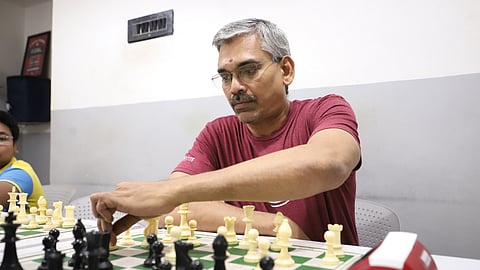
It might seem like all chess at first. But FIDE Master M Kunal is busy narrating a story to his students, not about chess, but cricket. It is the story of how Anil Kumble played Test cricket with a broken jaw. The story has little to do with chess. But perhaps everything to do with it. Kunal is preparing his students for the battles beyond the 64 squares.
Chess Gurukul may have begun in 2008, but RB Ramesh's foray into coaching started a decade earlier. In 1998, the then 22-year-old was entrusted with coaching a young Aarthie Ramaswamy. He was still an active player, but the partnership quickly bore fruit. A year later, Aarthie won the World Under-18 Girls' Championship in Spain.
That victory made Ramesh realise that perhaps his future lay away from the chess board.
“At the time, I was balancing life as an active player with a job at Indian Oil Corporation. Eventually, I realised that competitive play wasn't bringing me much joy anymore; I struggled to push past the 2600 rating mark and reach the very top tier,” RB Ramesh told DT Next.
In 2008, Ramesh retired from competitive chess, left his job at IOC, and co-founded Chess Gurukul with his first student and now partner, Aarthie.
Since his foray into the sport, chess has seen a drastic landscape change, both in India and globally. Until 1999, there were just three Grandmasters in the country: Viswanathan Anand (1988), Dibyendu Barua (1991) and Pravin Thipsay (1997). "Between Anand’s GM title in 1988 and roughly 2000, technology barely factored into preparation. Computers were a luxury, internet connections were sluggish, and everyone studied via physical books and face-to-face interaction,” Ramesh said.
“The biggest leap in that era occurred after the collapse of the Soviet Union, when elite trainers from former Soviet republics began coaching abroad. India brought several of them over to work with national squads and promising talents, which raised our tactical and positional understanding.”
The turn of the millennium brought better technology, more international coaches and a generation of Indian players who began travelling extensively in search of stronger competition. Hence, the number of Indian Grandmasters began to rise, starting in the 2000s with Abhijit Kunte, Krishnan Sasikiran (2000), Pentala Harikrishna (2001), RB Ramesh (2003). The country’s first Woman Grandmaster (WGM), Subbaraman Vijayalakshmi (2001) was also from the state.
It also meant that the sport was growing globally, with Europe quickly becoming the hotbed for norm-hunts. “Next came powerful chess engines and accessible software, allowing dedicated players to analyse deeply on their own without leaning constantly on a trainer. Pioneers like Krishnan Sasikiran then proved that frequent norm-hunting campaigns across Europe could forge top-tier Grandmasters.”
But once the pandemic (COVID-19) hit the world, chess became people’s new obsession. More platforms started to grow, with ChessBase India capturing the wild imagination of the public in the country, and online platforms like Lichess and Chess.com becoming more than just domains, becoming a part of people’s everyday routines.
“The pandemic created the biggest explosion yet. Overnight, geography ceased to matter: students began playing and learning online at scale, gaining instantaneous access to elite international coaching and round-the-clock competition."
Ramesh has seen the transformation first-hand. He started training in 1998 and remains an active trainer and mentor at Chess Gurukul and his newest venture, Chola Chess, backed by the Cholamandalam Group, a prominent financial services and investment arm of Murugappa Group. It is no surprise that he has trained some of the best players in the world chess scene, including the sibling duo of Praggnanandhaa and Vaishali Rameshbabu.
The 50-year-old has also worked extensively with Women’s Chess World Cup champion Divya Deshmukh and helped build Savitha Shri’s repertoire. So, what separates them from the thousands of students who have walked through the Gurukul's doors?
"At Chess Gurukul, we’ve had the privilege of working with many of the country's brightest stars—including Praggnanandhaa, Vaishali, Divya Deshmukh, and Savitha Shri. Pure talent is essential, but talent alone rarely carries anyone to the absolute top. The true differentiator is singular focus.
“For players like Pragg and Vaishali, chess became their non-negotiable priority at an early age. Today’s kids are constantly pulled away by distractions—video games, endless scrolling, or even building social media presences.”
“It wasn’t that Pragg and Vaishali lacked childhood curiosities; rather, they possessed the maturity and self-discipline to eliminate noise that regular kids indulge in. They channelled every ounce of their daily energy into study, calculation, and self-correction. That level of ruthless prioritisation and relentless work ethic is what separates elite champions from merely gifted players."
A board, 64 squares, 16 pieces. It looks like one of the cheapest sports a child can pursue. But reaching the top tells a very different story. Ramesh breaks down the economics, stating that it takes anywhere from Rs 50 lakh to Rs 1 crore to become a Grandmaster in the country.
“In reality, pursuing it professionally requires massive financial investment. The two largest expenses are elite coaching and foreign travel. High-level Grandmasters typically charge upwards of Rs 3,000 an hour, and because many parents insist that their children study only with GMs, training costs add up quickly,” Ramesh states.
“On top of that, India lacks high-density norm tournaments because local open events often accept large pools of lower-rated entrants to generate entry fees, diluting the competitive strength of the field. To score GM norms, serious aspirants are forced to travel to Europe, which is a massive financial burden.”
On average, a return flight to Europe ranges from Rs 80,000 to Rs 1 lakh, and once accommodation is added, the cost of a tournament can quickly rise beyond Rs 1.5 lakh.
“The overall expense depends on a player's trajectory, but even for a student progressing at an exceptional pace, reaching the Grandmaster title easily costs between Rs 50 lakh and Rs 1 crore.”
“Consider the logistics: when an underage player travels with a parent, airfare alone hits Rs 2 lakh per trip. If they make five European trips a year, that is Rs 10 lakh annually just on flights. Over five years, a family could spend Rs 50 lakh on airlines alone, before factoring in coaching fees, lodging, or living expenses."
Why Europe? The problem isn't just the cost of coaching. Ramesh believes India's tournament ecosystem is also forcing families to spend heavily overseas.
“What India truly lacks today is high-calibre domestic competition. This is where corporate capital can make a definitive impact. We urgently need closed, high-standard domestic events with rating cutoffs – say, 2200 Elo and above. By curating stronger, higher-rated fields at home, our prodigies wouldn't need to empty their savings travelling across Europe just to earn Grandmaster norms."
Ramesh believes private investment can help bridge that gap. “Fortunately, India now has a strong network of elite coaches, making world-class guidance far more accessible than it once was. For example, we launched an initiative backed by the Cholamandalam Group, offering fully sponsored monthly training camps to nearly 300 promising youngsters scouted across the country.”
Traditionally, Tamil Nadu has been the mecca for chess in the country, with the first International Masters, Grandmasters, and Woman Grandmasters all from the state. If Manuel Aaron laid the seed of this chess revolution, Anand has taken chess to the households, inspiring generations of kids to take up the sport.
No surprise that even the first Woman Grandmaster (WGM) is from the state: Subbaraman Vijayalakshmi. So what gave Tamil Nadu such an early advantage over the rest of the country
"Tamil Nadu's head start comes down to two structural advantages: an active governing body and an early academy system. The Tamil Nadu State Chess Association organized regular tournaments when other states held very few; as a kid, I remember players from all across India having to travel here just to find competitive games.”
“Furthermore, Chennai developed a professional coaching culture decades ahead of other regions. Decades of institutional infrastructure provided kids with regular game time and structured training.”
“Tying that whole ecosystem together was Viswanathan Anand. I personally picked up the game because I read about him making Grandmaster in the newspapers. For over three decades, Anand has acted as a magnetic force, pulling successive generations of Indian children toward the chessboard."
Now, in 2026, Tamil Nadu has around 37 Grandmasters, 33 International Masters, and seven Woman Grandmasters, making it a hotbed not just of Indian chess but of world chess too. For all the growth chess has witnessed in India, the journey to the top remains an expensive one.
The board still has only 64 squares. But for a young Indian dreaming of becoming a Grandmaster, the journey beyond them can require years of sacrifice, international travel, elite coaching, and, according to Ramesh, as much as Rs 1 crore.