
- Chennai
- Tamil Nadu
- India
- World
- EntertainmentEntertainment
- Business
- Sports
- Lifestyle
- Technology
- Videos
- Explainers
- Editor's Picks
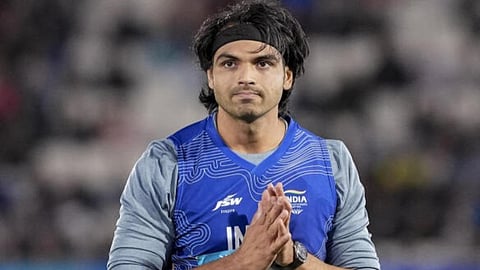
NEW DELHI: India's star javelin thrower Neeraj Chopra termed his absence from the Asian Games unfortunate but said it was important to "accept" the setback and focus on making a quick comeback.
The 28-year-old, who won India's first Olympic gold medal in athletics with his javelin triumph at Tokyo and followed it up with a silver in Paris, missed out on a chance to complete a hat-trick of Asian Games gold medals after suffering a ligament injury while training.
The injury came soon after Chopra produced a season-best throw of 88.05m at the Lausanne Diamond League, bringing his 2026 competitive season to an early end and ruling him out of the Asian Games and the Diamond League Final.
"It is definitely difficult. I wouldn't say it is easy," he said on the Khelo Bharat Podcast of the Sports Authority of India (SAI).
"It has become a little normal for me because this has happened quite a few times in my career. There have been times when I was very well prepared and suddenly suffered an injury.
"Even after winning many things, you still feel that if you had been able to use that time without the injury, perhaps even better things could have happened."
Chopra said the latest injury was particularly frustrating because he felt he had finally returned to his best after recovering from an earlier setback.
"When I felt that I was finally back to being the old Neeraj again, with the same enthusiasm and consistency, I threw 88 metres. Then, just a day later, I got injured again during training. The first few minutes were very difficult for me. I couldn't process what was happening," he said.
"I pushed myself so much, mentally and physically. I had started training right from the beginning of the year. I hadn't really spent any time with my family. I had focused completely on training and competitions because it was a very busy year.
"I kept thinking that after doing so much, I had ended up back at the same place where I was at the beginning of the year."
The former Olympic champion said he allowed himself to feel disappointed rather than trying to immediately brush the setback aside.
"I felt bad, and I allowed myself to go through that process. I didn't fight with myself and say, 'Forget it, it's okay.' I felt really bad initially."
"But I think the best thing for an athlete when an injury happens is to accept it as quickly as possible. So that's what I did. I thought, 'It has happened. Now let's work on how to make a comeback.'"
Chopra further said the timing of the injury was unfortunate, with several major competitions lined up, but said he had shifted his focus towards next year.
"The timing was unfortunate because I had some very important competitions coming up. But then I thought, maybe this was meant to happen. It has happened, so now let's focus on the competitions coming next year."
Asked what he would tell Indian athletes competing at the Asian Games, Chopra urged them to make the most of a rare opportunity.
"I would simply tell them to give their best. You get opportunities like the Games once every four years, so don't leave with anything in your mind that makes you feel later, 'I could have done this'," he said.
"Rather than waiting another four years, visualize yourself properly and then give 100 per cent there, so that you have the satisfaction of knowing that you gave everything for the hard work you had put in.
"My best wishes to everyone, and I hope India gets a very good result at the Asian Games and everyone achieves the performance they are targeting."
The injury has also given Chopra more time at home.
"Finally, I'm home. It's a different matter that I had a different goal for this year, but because of the injury, that didn't happen. But it's okay. At least I've got some family time at home."
But Chopra said the athlete in him would soon want to return to training.
"The target is to start training and rehabilitation again soon because these things feel good for a few days. If training isn't happening, everything starts feeling boring.
"So I'll gradually start training again. It makes things more enjoyable because training also keeps my mind calm."
Chopra also spoke candidly about how he gradually learned to deal with criticism on social media.
"Earlier, if I read a negative comment, I would feel bad. Coming from a village, I wasn't mentally prepared for people saying such things. It did affect me.
"Gradually, I learned that it doesn't matter because I know what I have done for the country and how much hard work it takes to reach this level."
For aspiring javelin throwers, Chopra's central message was patience.
"I would say one thing: I took five years to cross 80 metres," he said.
"Now I meet juniors who have been doing it for two years and ask, 'When will I throw 80 metres?'
"Patience is extremely important. Don't push yourself too much because javelin is already an injury-prone sport," he said.