
- Chennai
- Tamil Nadu
- India
- World
- EntertainmentEntertainment
- Business
- Sports
- Lifestyle
- Technology
- Videos
- Explainers
- Editor's Picks
Mauricio Pochettino once said that soccer “is timing.”
It was late 2022, and he was out of work, invited to reflect on whether his hopes of landing one of the two biggest jobs in world soccer, at Real Madrid and Manchester United, might have come and gone.
He felt they had not. “Sometimes it is only a question of time,” he told Radio Marca. “I don’t believe in trains passing only once. I think sometimes you need patience and you have to know how to wait.”
The stars have never quite aligned for Pochettino at Real Madrid, which he once described as his dream job. He had just signed a new five-year contract at Tottenham Hotspur when Real Madrid sounded him out after Zinedine Zidane stepped down in the summer of 2018. When he was in their thoughts again in the summer of 2021, he was four months into an 18-month deal at Paris Saint-Germain. At the end of last season, as he prepared to lead the United States into the World Cup, he was a fleeting consideration, but not much more.
With Manchester United, it has been a different matter. There were overtures from Old Trafford in the spring of 2016 and haltingly in late 2018, as they scoured the market for a replacement for Louis van Gaal and then Jose Mourinho, but he was fiercely committed at Tottenham. He was seriously interested in 2022, as his rocky spell at PSG neared an end, but United went for Erik ten Hag instead. He was interviewed in 2024, but the United hierarchy was unenthused and granted Ten Hag a stay of execution before hiring Ruben Amorim, by which time Pochettino had taken charge of the U.S. team.
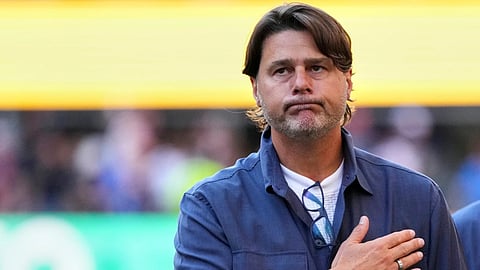
In the end, though, Pochettino was right about timing — in connection with this job, at least. According to people with knowledge of the negotiations, Manchester United is working on a deal to appoint Pochettino after removing Michael Carrick as head coach on Thursday.

Wait around long enough, and that particular train is sure to pass through again.
That is what Manchester United has become. It has gone from a once-in-a-generation job, held by Alex Ferguson for 26 years, to one that comes around on a shorter and shorter loop these days. It is not quite Chelsea or Nottingham Forest territory, but the team’s last two coaches, Amorim and Michael Carrick, lasted less than 10 months, and now Pochettino finds himself back en vogue.
Some will wonder why Pochettino would leave his current post for the Old Trafford madhouse, which would reportedly require United to pay a contract buyout of around $10 million. United is in the Premier League’s relegation zone after winning just one of its first 10 games this season, and the state of dysfunction is arguably greater and the league position certainly more perilous than at any stage in the 13 mostly miserable years since Ferguson stood down.
The truth is that the job remains one of the most alluring in world soccer. It is not as attractive as it should be — it has 21 years under the ownership of the Glazer family, not helped by two years of Jim Ratcliffe’s questionable influence, to thank for that — but attractive nonetheless. It is just the type of job that Pochettino would have had in mind when he asked for a buyout clause to be inserted in the four-year contract he signed with the U.S. Soccer in August.
The bigger question is whether Pochettino — and specifically the Pochettino of 2026, only 54 years old but some way removed from the hip gunslinger of a decade ago — can succeed where David Moyes, Van Gaal, Mourinho, Ole Gunnar Solskjaer, Ralf Rangnick, Ten Hag, Amorim and Carrick have all, to varying degrees, failed over the past 13 years.
If there were a perfect time for United to move for Pochettino, it was late 2018, when his stock was still on the rise at Tottenham, en route to the Champions League final but with questions asked about the club’s prospects of long-term improvement. He was initially United’s favored candidate post-Mourinho, but Solskjaer had such an impressive immediate impact as interim — 14 wins, two draws and just one defeat in his first 17 games, culminating in a dramatic Champions League victory over PSG — that the United hierarchy rushed to sign him to a three-year deal.
Specifically, Pochettino seemed right for the type of cleanup and rebuilding operation that the United job represented at that juncture. Would he have matched Solskjaer’s remarkable initial impact? Almost certainly not. But his record at Espanyol, Southampton and Tottenham showed him to be one of best young coaches in Europe, adept not just at improving teams in the short term but changing their trajectory in the longer term. He led Southampton to 14th (41 points) and eighth place (56 points) in the Premier League, then Tottenham to fifth (64 points), third (70 points) and second (86 points) in his first three seasons, primarily through improving and developing players, individually and collectively, rather than looking to the transfer market.
It is difficult to appraise Pochettino’s post-Tottenham career, not least because of the jobs he has taken. Trying to instill hunger, tactical discipline and out-of-possession rigor — three of his non-negotiables — was a struggle for every PSG coach at the time, particularly after the club added Lionel Messi to a star-studded forward line that already included Kylian Mbappe and Neymar.
His season in charge of Chelsea, in which the team meandered before belatedly finding form and ending up sixth in the Premier League, was about par for the course in this chaotic era at Stamford Bridge. The United States briefly looked one of the best-drilled teams at the World Cup as it won its group and beat Bosnia-Herzegovina comfortably in the round of 32, but it was so comprehensively beaten by Belgium in the next round that his overall impact became harder to evaluate.
Anyone who watched his Southampton and Tottenham teams will know and perhaps appreciate the type of soccer that Pochettino loves to play: high intensity, built on a sound defensive structure yet firmly committed to attack. There were glimpses of it at Chelsea, particularly toward the end, and many of the players there were disappointed to see him depart. But there were also times when he appeared to be banging his head against a brick wall, confounded by individual and collective meltdowns of a type that will be familiar to anyone watching United in recent weeks. Trying to get this mishmash of a squad to embrace a high-intensity pressing style threatens to test his patience as much as anything.
There have been mitigating factors: the “flashy bling-bling” culture at PSG that was so at odds at with his approach to team building in particular; the circus that had taken residence at Chelsea, whose obsession with signing young players by the dozen has at times appeared diametrically opposed to the needs of successive coaches; the reality that the U.S. job, going into the World Cup, was at least partly about raising hopes and expectations to a level that he and his squad had little prospect of meeting.
But then what is the Manchester United job these days if not a poisoned chalice? If what he has craved since leaving Tottenham is a calm, stable environment, then seriously, Mauricio, have you thought this through? Have you looked at the Glazers’ track record, both before and since Ratcliffe arrived with a team of executives who have got just about every big decision wrong over the past couple of years? Have you looked at the results of this summer’s long-awaited overhaul of the midfield department? Have you seen the team play this season? Or indeed any time over the past 3 1/2 years, outside of that period in the second half of last season when Carrick, all too briefly, put them back on the rails?
It will be a colossal challenge. Improving United in the short term should be straightforward enough, as Carrick demonstrated last season, but for years this club has needed someone who can change habits, raise standards and improve results beyond the first phase of the operation. At times people rushed to declare that Van Gaal, Mourinho, Solskjaer, Ten Hag and Carrick succeeded in transforming the mood and the culture around the place, but nothing works for long. Long-serving players such as Scott McTominay, now at Napoli, and Luke Shaw used the word “toxic.” Carrick’s air-freshener approach, however welcome it was last season, never seemed likely to work beyond the short term.
Pochettino is the kind of coach who appears more likely to embrace that challenge, to identify and try to root out bad apples rather than seek the path of least resistance. But it is so much easier for a coach to do that when he arrives in the summer, with the opportunity to evaluate the squad, look to the transfer market and try to improve habits, standards, fitness levels and cohesion over the course of a preseason training program than it is in mid-November when you are in the relegation zone and there is a desperate need to improve results — starting against Liverpool at Anfield on Nov. 22.
This is what happens when a club continually makes poor decisions, leaving one coach after another to try to find an antidote to the malaise that began in the boardroom and spread to the dressing room, creating the growing feeling that Manchester United has become unmanageable.
What appeals to coaches, even now, is the prospect of being the one who restores the club to its former glories. But to return to what Pochettino said about the importance of timing, this does not feel like the ideal time for anyone to take over Manchester United with that particular aspiration in mind.
This time the stars have aligned to make that union possible, but the challenge awaiting an incoming manager at Old Trafford has rarely looked so daunting.