
- Chennai
- Tamil Nadu
- India
- World
- EntertainmentEntertainment
- Business
- Sports
- Lifestyle
- Technology
- Videos
- Explainers
- Editor's Picks
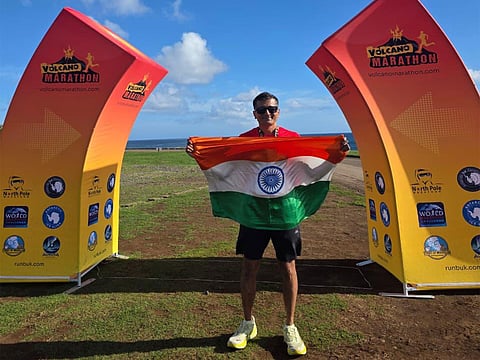
NEW DELHI: Ram Gopal Kothari insists he is not a runner but a traveller. And his insatiable hunger to explore has taken the Kolkata entrepreneur from the North Pole to one of the world's most remote inhabited islands, Rapa Nui in Chile, where he became the first Indian to complete the Volcano Marathon.
Less than a year after becoming the first Indian to complete a marathon at the Geographic North Pole, the 45-year-old Kothari has scripted another first, this time on Rapa Nui, also called the Easter Island, famed for its mysterious Moai statues and dramatic volcanic landscape.
The journey involved travelling more than 24,000 kilometres from India. It was also the 80th country that Kothari set foot on in his eventful life.
"I have become the first Indian to complete the Volcano Marathon on Rapa Nui (Easter Island), Chile, one of the world's most remote inhabited islands. The journey involved travelling over 24,000 kilometres from India via Mumbai, Istanbul and Santiago before reaching Rapa Nui...," he told PTI in an interview.
"As with my previous expedition, this journey was about pushing the boundaries of endurance and inspiring others to dream beyond limits," he added.
The records are, however, merely significant milestones in a much larger journey.
"You used the right word, hunger. Now, it has become a little like hunger," he said when asked what keeps drawing him to some of the world's most unusual marathons.
That hunger first took him to Antarctica in 2022.
While travelling there, he became fascinated by the idea of visiting the Geographic North Pole and stumbled upon a marathon organised in the Arctic.
The original event was held at 89 degrees North before participants were flown to the Pole by helicopter. When organisers later introduced a format that staged the race directly at 90 degrees North, Kothari signed up and became the first Indian to complete the event.
But another destination still remained to be checked in his bucket list.
"Easter Island was one of my dream places. So, I had to go to Easter Island one day because I was seeing Easter Island for a long time. There are statues of Moai. Nobody knows who installed them," he said excitedly.
The mystery surrounding the giant stone statues had fascinated him for years.
When he learnt that adventure marathon organisers Runbuk conducted the Volcano Marathon there, combining travel with another endurance challenge became an easy decision.
Unlike his North Pole expedition, Kothari says he approached the Easter Island run with far greater preparation.
Earlier, he mostly ran half marathons, including the Tata Mumbai Marathon and the Kolkata Marathon. This time, however, he tailored his training specifically for the demanding terrain, which features nearly 600 metres of elevation gain and long stretches of rugged volcanic trails.
"I took the marathon very seriously this time," he said.
He completed several practice runs of 25 to 26 kilometres and stretched his longest training run to 30 kilometres. Knowing the course involved steep climbs, he repeatedly trained on the ramps at Kolkata's Salt Lake Stadium.
Evenings were spent walking for an hour on an inclined treadmill to simulate elevation gain, while he also focused on improving endurance rather than simply increasing speed.
"Practice makes a man perfect. This time, I took the marathon with a different and more confident approach."
Much of that preparation was shaped by North Kolkata Runners' group captain Vikas Duggar, whom Kothari credits for transforming his approach to marathon running.
"He told me that because your elevation is 600 metres, you should do ramp running. He also guided me on using energy gels for long-distance running."
The advice paid off.
"I was the only one, believe it or not, among all the people, who did not get any cramp," he said proudly.
"My room partner from China had done around 70 marathons throughout the world. They were also getting cramps and obviously I finished much before him."
The Volcano Marathon itself proved every bit as demanding as its reputation.
The opening 21 kilometres were on paved roads but featured continuous elevation changes that steadily tested the runners.
Beyond that, the route changed dramatically as it entered rugged volcanic terrain strewn with loose rocks, potholes and uneven surfaces, demanding complete concentration with every step.
"The problem started after 21 kilometres. As soon as you turned there, the road started to become rough."
The scenery, however, was unlike anything Kothari had experienced before.
"There were horses, there was a valley of yellow flowers and the Pacific Ocean all around. People got distracted and I saw four or five runners slipping."
The steep climb to the Rano Kau volcanic crater became the defining challenge of the race.
"The toughest part was when we started climbing on the Volcano Crater. That hill was so steep that it was very difficult to walk there. This five kilometres was the most difficult part for me," he recalled.
If the climb tested endurance, the closing stages demanded resilience.
"The last two kilometres, yes, it was the most difficult part of the run because the raw road was also broken. I don't know how I reached the last two kilometres."
Yet, despite the physical challenge, Kothari said the island offered the most breathtaking marathon course he has encountered in his travels.
"I have visited 80 countries. Antarctica was the most beautiful. But if you talk about greenery, scenery and nature, it is difficult to find a place like Easter Island.
Where will you find a place where you are running and horses are running behind you? Not one, not two, but 10 horses are running behind you. The blue Pacific Ocean is in your surrounding. I have never seen such a beautiful place for running in my life."
His thoughts are fixed on Antarctica once again, where he plans to attempt a 24-hour ultra marathon in November this year.
His target is to cover 120 kilometres in temperatures that could drop to minus 40 degrees Celsius, a feat no Indian has achieved.
