
- Chennai
- Tamil Nadu
- India
- World
- EntertainmentEntertainment
- Business
- Sports
- Lifestyle
- Technology
- Videos
- Explainers
- Editor's Picks
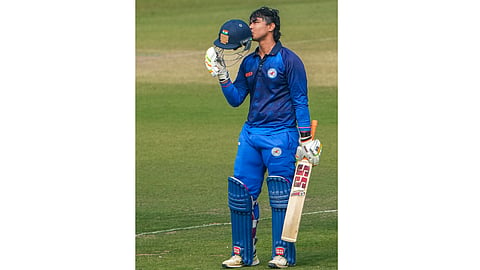
NEW DELHI: The scoreboards see runs. The selectors see talent. The public sees a phenomenon. But somewhere beneath the helmet and behind the growing celebrity is a 15-year-old still negotiating the uncertainties of adolescence.
As India celebrates the astonishing rise of batting prodigy Vaibhav Sooryavanshi and eagerly awaits his debut, another conversation is quietly unfolding beyond his audacious strokeplay and remarkable poise.
It is a conversation that elite sport has wrestled with for decades: when extraordinary children enter an adult world, how does one ensure that exceptional talent does not come at the expense of a normal and ordinary childhood? There are no easy answers.
If merit alone determines selection, Sooryavanshi deserves to be where he is. His recent performances in the IPL and other tournaments have made that case emphatically.
Yet the arrangements surrounding his maiden senior tour are a reminder that cricket's newest sensation is still legally a child.
The BCCI has allowed his parents to accompany him, while safeguarding regulations in England require separate changing-room arrangements for minors.
A boy considered mature enough to face international fast bowlers, but young enough to need the protection that childhood demands.
For leading sports psychologist Keerthana Swaminathan, that distinction should never be forgotten.
"A 15-year-old is still a child before he's a star. But we end up interchanging that. We end up thinking he's a star first and then a child," Swaminathan told PTI.
"We need to make sure we understand what we can expect from a child. Obviously, they have to have the scope to make mistakes.
"Understanding that they are children first before performers would be really helpful because, when they are performing, they already have to work on a hundred other things. They have to work on their own emotional and mental stability. This is a very high-pressure scenario," she said.
Those words perhaps capture the dilemma better than any statistic.
From cricket to tennis, football to gymnastics, every generation has marvelled at youngsters capable of competing against athletes far older and physically stronger.
Some have justified every expectation placed upon them. Others have discovered that talent alone is not enough to navigate the emotional demands of early fame.
Indian cricket itself has witnessed teenage debuts before.
Sachin Tendulkar was just 16 when he walked out to face Pakistan's fearsome pace attack in 1989. History would remember him as perhaps the greatest batsman of his generation.
Yet Tendulkar's arrival belonged to another era. There were no social media clips dissecting every innings, no round-the-clock television ecosystem hungry for constant headlines and instant opinions, and no broadcaster commitments and promotions. Praise travelled slower. So did criticism.
Today's teenage prodigies grow up in an environment where every shot, every dismissal and every facial expression can become public property within minutes.
That, Swaminathan believes, changes the psychological landscape.
"I don't think protection is the only way to go. Now that he's also in this space, the media is going to talk. Social media is going to talk. Some people are going to talk.
"Parents can't take away the sadness or the anger, but they can lend a shoulder and equip children with the tools they need to deal with those emotions," she pointed out.
Modern sports science increasingly echoes that thinking.
Studies in sports psychology suggest that early success itself is not the problem. Rather, the greater risks arise when extraordinary expectations, relentless scrutiny and an athlete's identity become inseparable from sporting performance.
Researchers have also highlighted the importance of supportive family environments, balanced development and allowing young athletes the freedom to make mistakes without defining themselves solely through results.
History offers enough reminders that the road from prodigy to champion is rarely straightforward, although there are cases when a teenaged talent has charted a sustained career graph.
Women's tennis, in particular, has witnessed remarkable youngsters whose journeys became cautionary tales as much as sporting fairy tales.
Jennifer Capriati became one of the biggest names in world tennis while still in her teens. The enormous expectations that accompanied her rise were followed by personal struggles before she remarkably rebuilt her career to become a multiple Grand Slam champion.
Tracy Austin conquered the sport as a teenager, only for injuries to curtail what many believed could have become one of the game's greatest careers.
Their stories are not evidence that early success is inherently harmful. They are reminders that precocious talent often walks hand in hand with extraordinary pressures. Cricket, too, has seen teenage sensations whose careers unfolded in dramatically different ways.
Some, like Tendulkar, fulfilled every promise and more. Others, including Prithvi Shaw, announced themselves with promise but found sustaining that trajectory at the highest level far more challenging, illustrating that early success guarantees neither longevity nor fulfilment.
For Swaminathan, the responsibility extends well beyond the athlete. She believes parents, coaches and sporting systems must remember that children process success and failure differently from adults.
"I've worked quite a bit with parents and coaches. I believe in creating environments where athletes can thrive, where children can actually thrive. Somewhere something gets lost in communication. We end up talking to children like we would talk to a 20-year-old or a 30-year-old. But we forget that they're actually 15-year-olds," she said.
She recalls one young athlete telling her: "He said 'Ma'am, I'm confused whether my parents are happy or not happy. If I play well, sometimes they're angry. If I don't play well, sometimes they tell me I've done really well. I'm not able to understand'." Such moments, she says, underline how easily adults can forget that adolescence is itself a period of emotional discovery.
Equally important, she argues, is allowing youngsters to experience emotions rather than shielding them from every disappointment.
"If a child is feeling sad, maybe learning how to use that emotion while performing... knowing how to reflect is a big tool. People think it's wrong to have emotions or to be sensitive. But emotions exist for a reason. They can become the biggest teachers." None of this diminishes the achievements of someone like Sooryavanshi. Nor does it argue that exceptional youngsters should be denied opportunities simply because they are young.
In a recent column for 'ESPNCricinfo', former South African cricketer, Daryll Cullinan, who himself started his first class career at a very young age, talks about the pitfalls of pitching young talents into the mainstream too early..
"In my view he (Sooryavanshi) should be at home preparing for his exams, playing gully cricket with his mates, and being a young boy while he still has the chance.
"That does not mean ignoring his talent. It means understanding that the talent will only be truly served if the person carrying it is allowed to grow whole," he wrote.
Former left arm spinner Maninder Singh, who made his debut for India at 17, believes self-discipline and performance are the key factors to retain place in the team.
"I was dropped after my first two tours as in eight Tests, I picked five wickets. I had no one to blame. Yes, umpiring was horrible in Pakistan and also the West Indies but that's not all. I didn't play well and I had to make way," Maninder told PTI, recalling his early days in international cricket.
"Of course there was a support system back then also. There were people who came and told me 'Listen Manni, you need to work harder'. If I have to blame anyone it will be myself. Now there is a better support system that is working for players," he said.
If anything, the emergence of such rare talent is something every sporting nation celebrates. The challenge is ensuring that systems evolve as rapidly as the prodigies they embrace.
For every record broken by an extraordinary teenager, there remains a quieter responsibility shared by everyone around them -- to remember that before becoming the country's newest sporting star, they are, first and foremost, still children.