
- Chennai
- Tamil Nadu
- India
- World
- EntertainmentEntertainment
- Business
- Sports
- Lifestyle
- Technology
- Videos
- Explainers
- Editor's Picks

CHENNAI: Villivakkam constituency has emerged as one of the most high profile electoral battlegrounds in Tamil Nadu, drawing statewide attention after the entry of TVK’s Aadhav Arjuna and DMK’s young candidate Karthik Mohan.
With both parties fielding strong and resourceful faces, and the AIADMK also announcing SR Vijay Kumar for the Villivakkam constituency, the seat has gained ‘star candidate’ status.
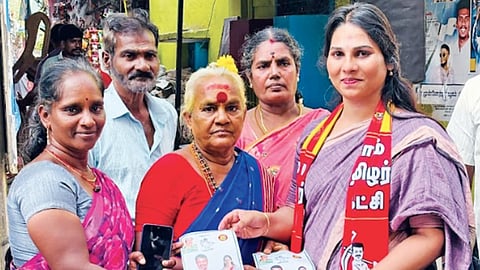
However, amid this high voltage contest, Naam Tamilar Katchi (NTK) candidate S Roshini has introduced a striking and trendsetting dimension to the race. During an intense day of campaigning, DT Next visited the constituency and met NTK candidate S Roshini, one of the two transwomen candidates contesting in Tamil Nadu.
What stood out was not a large rally or high budget campaign, but a modest street-level outreach at Pali Amman Koil Street. In contrast to the resourceful heavy campaigns of her rivals, Roshini’s approach was grounded and direct, engaging with voters alongside NTK cadre who spoke strongly on Tamil identity and local civic issues. Roshini engaged directly with voters, while party speakers strongly projected Tamil identity and grassroots issues.
Despite the scale difference compared to major party campaigns, her presence and message drew noticeable public interest.
While DMK and TVK campaigns continue to dominate in terms of visibility and resources, Roshini’s ability to hold ground in a constituency dominated by powerful opponents has made her one of the most talked-about candidates in Villivakkam.
A key point of contrast in this contest is the financial strength of the candidates, as revealed in their affidavits. DMK candidate Karthik Mohan has declared assets worth approximately Rs 201 crore, while TVK’s Aadhav Arjuna has reported a net worth of around Rs 172 crore.
In contrast, Roshini has declared total assets of about Rs 18.3 lakh, highlighting a significant economic gap between her and her rivals.
Roshini’s candidature carries both symbolic and political weight. As the only trans woman candidate in TN, her participation reflects a consistent shift toward inclusivity in State politics. Historically, trans women representation in Indian elections has been limited, with only a few notable successes at the state and local levels.
Leaders such as Shabnam Mausi, elected as an MLA in the 2000 Assembly election from Madhya Pradesh, the first trans woman elected to a State Assembly, and Madhu Kinnar, elected as the Mayor of Raigarh in 2015 from Chhattisgarh as an independent candidate, have paved the way. However, representation in legislative assemblies and Parliament remains minimal.
Roshini said that Dravidian majors like DMK and AIADMK mostly rely on freebies, but NTK was different. “We aim to provide pure potable water, quality education, and good medical care for all free of cost,” she said. “NTK has come not just for an electoral change, but for a political change. I’ve been working as an environmental activist for the past 10 years from Tiruchy. Neither AIADMK or DMK are concerned about future generations. They loot the natural resources like mountains and river sand. If NTK comes to power, we’ll create sustainable development and a better future for our generation.”
Asked about her fellow candidates in the Villivakkam constituency, she said that people were already angry with the DMK due to anti-incumbency, and that the AIADMK’s alliance with the BJP will not be accepted by TN voters. “TVK does not have a solid ideology and relies mainly on Vijay’s face value, which may not work in politics,” Roshini pointed out.
As the campaign intensifies, Villivakkam is no longer just a contest between major parties. It has evolved into a constituency where a trend-setting trans woman candidate is challenging conventional political dynamics and trying to redefine what electoral representation can look like in Tamil Nadu.