
- Chennai
- Tamil Nadu
- India
- World
- EntertainmentEntertainment
- Business
- Sports
- Lifestyle
- Technology
- Videos
- Explainers
- Editor's Picks

K Ashok Vardhan Shetty
A three-hour multiple-choice test may reveal something, but it cannot reveal everything — and it must not decide everything for our youth
By eclipsing regular school board performance, high-stakes centralised tests create an implicit geographic filter that rewards expensive coaching over consistent merit
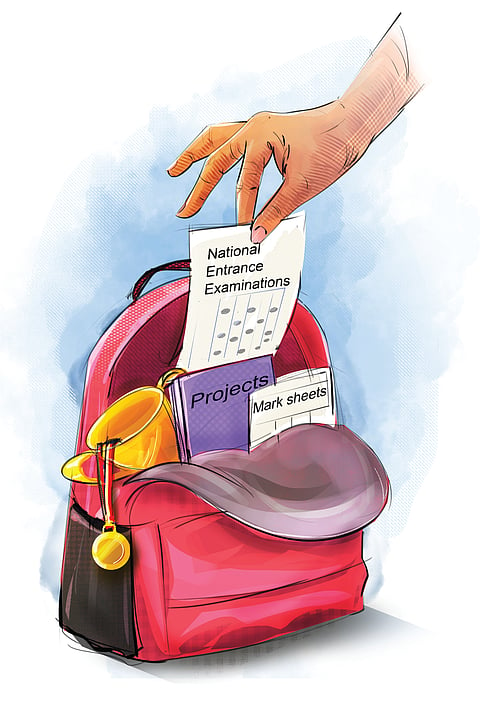
A clear sign of the centralising drift in education is the proliferation of high-stakes national entrance examinations for undergraduate and postgraduate admissions. They are defended in the attractive but often unexamined rhetoric of “merit” and “uniform standards”. These tests fall into two broad categories.
The first comprises legally mandatory tests binding all institutions — Central, State, government, and private. The National Eligibility-cum-Entrance Test (NEET) regime for medical education, covering NEET-UG, NEET-PG, and NEET-Super Specialities (SS), falls within this category. By displacing School Board and university performance, NEET curtails States’ control even over their own medical colleges, undermining both State authority and university autonomy.
The second category comprises national entrance examinations limited to Central Institutions and Institutions of National Importance. The Joint Entrance Examination (JEE), Common University Entrance Test (CUET-UG), and Common Law Admission Test (CLAT) follow this model.
The deeper concern lies ahead. The Union Government increasingly appears to treat NEET not as an exceptional arrangement for medical admissions, but as a template for extending “one nation, one examination” to engineering, law, the arts and sciences, further eroding State control and university autonomy. More fundamentally, it rests on an unproven premise: that a single, national, multiple-choice-question (MCQ) -based entrance test measures merit more accurately than sustained performance in School Board or undergraduate university examinations. The evidence, however, points the other way.
In a 2007 University of California study of more than 80,000 students, Saul Geiser and Maria V Santelices found high-school grade-point-average (GPA) to be a stronger and more consistent predictor of college performance and graduation than SAT scores, which were more closely associated with family income and parental education.
WG Bowen, MM Chingos and MS McPherson’s 2009 study of entrants to 68 public universities found that high-school GPAs predicted graduation better than SAT scores. GPA captured perseverance, consistency and work habits, while SAT performance often mirrored unequal opportunities.
William Hiss and Valerie Franks’s 2014 study of nearly 1,23,000 records from 33 American institutions likewise found high-school GPA the strongest predictor of college success, with standardised tests adding little. Graduation rates differed by just 0.6 percentage points between test-submitters and test-optional admits.
Elaine Allensworth and Kallie Clark’s 2020 study of 55,000 graduates of Chicago Public Schools from 2006 to 2009 found that high-school GPA was about five times more predictive of college graduation than ACT scores.
Comparable evidence emerged in the Netherlands, where Martijn Meeter’s analysis of 1,80,000 students found secondary-school GPA substantially better at predicting first-year retention than national examination scores; the latter added no predictive value once school performance was considered.
Evidence at the level of postgraduate admissions points in the same direction, though less uniformly. A 2017 Vanderbilt University study of 683 biomedical doctoral students found undergraduate GPA more predictive than GRE scores of graduate grades and PhD completion. A 2021 study of 1,955 physics doctoral students across 19 American universities reported broadly similar findings. Other studies, however, suggest that neither measure is independently sufficient and that the two may be most useful in combination.
Yet, neither the Union Government nor the Supreme Court has seriously examined this research. Both have treated the superiority of a single-day, multiple-choice national entrance test as axiomatic. A three-hour MCQ test may reveal something, but it cannot reveal everything and must not be allowed to decide everything.
Despite wide variations in curricula and assessment practices across their States, Australia, Germany, Canada, and the United States achieve national comparability without a federal entrance examination.
Australia converts State school-leaving results into the Australian Tertiary Admission Rank (ATAR), a percentile score from 0.00 to 99.95. An ATAR of 85.00 reflects the same relative standing nationwide, regardless of the State in which it was earned. This enables universities to compare applicants while States retain control over curricula and assessment.
In Germany, the comparability of Abitur (awarded at the end of secondary schooling) across the Länder is sought through common standards, shared pools of examination questions, and coordination by the Standing Conference of Ministers of Education and Cultural Affairs. Recognition is based on horizontal cooperation, not federal command.
Canada has no federal ministry of education; provinces control schooling and post-secondary education. Portability is secured through mutual recognition and inter-provincial coordination.
In the US, the SAT and ACT, administered by private organisations, provide common benchmarks across diverse school systems. The SAT assesses reading, writing and mathematics; subject-specific SATs were discontinued in 2021. The ACT covers English, mathematics, reading and science. Neither test is ordinarily decisive, and many universities make test scores optional. Admissions remain institutionally controlled, considering school performance, essays, recommendations, extracurricular achievement and social context.
These models cannot be mechanically transplanted to India. But they show that national comparability does not require a centralised examination that ignores sustained school performance. India’s priority is to strengthen schooling and restore confidence in Board assessments. To neglect them and then invoke “standards” to justify national entrance tests is administrative evasion — making students pay for the Union’s and States’ failure to reform schooling.
India already knows how to compare the apparently incomparable. In the Civil Services (Main) Examination, the UPSC offers 48 optional subjects — 25 disciplines and the literature of 23 languages, ranging from Assamese literature to Zoology. Though these subjects differ in content, difficulty and marking patterns, inter-subject scaling is used to ensure that no candidate is unfairly advantaged or disadvantaged by the choice of optional subject.
The Supreme Court has recognised the legitimacy of such statistical adjustment. In Sanjay Singh v. UP Public Service Commission (2007), it distinguished moderation, which corrects examiner variation in a common paper, from scaling, which places performance in different subjects on a common metric. In UP Public Service Commission v. Manoj Kumar Yadav (2018), it reaffirmed the use of scaling for comparing candidates taking different optional subjects, while cautioning against its mechanical use for common papers.
This refutes the claim that marks awarded by different School Boards are inherently incomparable. If statistical methods can fairly rank candidates across divergent subjects for India’s highest civil services, they can likewise harmonise School Board results for university admissions — through a transparent and periodically reviewed framework.
A common entrance test is often defended as a convenience because it spares students from applying separately to many institutions. This confuses two distinct functions: simplifying applications and assessing academic merit. Mature systems separate them. Common App in the United States and the Universities and Colleges Admissions Service (UCAS) in the United Kingdom enable students to apply to multiple institutions through a single platform, while universities retain control over admission criteria and selection.
India can likewise create a common portal for applications, documents, fees, preferences, counselling, and seat allocation, while preserving State and university autonomy. The solution to multiple applications is a common portal — not a common examination.
High-stakes national entrance examinations are especially unsuited to undergraduate admissions. School-leavers are adolescents from sharply unequal social, economic, linguistic, and curricular environments. Tests such as NEET and JEE are substantially aligned with the CBSE-NCERT framework, although CBSE students constitute only about one-eighth of candidates at the Board-examination stage, while roughly 85 per cent study under State Boards. Since CBSE schools are disproportionately urban, private, and better resourced, this alignment creates an implicit class and geographic filter.
Rural, poor, vernacular-medium and State Board students often encounter the national syllabus, technical vocabulary, MCQ format and coaching culture only near the end of schooling. Affluent urban students may have been coached for years. MCQ tests reward speed, elimination techniques, and question-pattern recognition, while discounting descriptive writing, practical work, and sustained academic performance. Tamil Nadu’s post-NEET increase in CBSE representation in medical admissions illustrates this distortion.
The social cost of entrance tests is grave. They impose do-or-die pressure on vulnerable adolescents, fuelling anxiety and distress. Good coaching is expensive and big-city-centric; it entrenches inequality and dresses privilege as “merit”. When entrance tests eclipse Board performance, secondary schooling loses relevance, teachers’ authority is undermined, and students’ socialisation and holistic development suffer. Such damage is indefensible when entrance tests have not been established as superior predictors and simpler statistical harmonisation methods exist.
The postgraduate stage stands on a different footing. Candidates are adults with recognised professional degrees, broadly comparable training, a shared technical vocabulary and greater familiarity with competitive assessment. A common examination is therefore relatively more defensible — but only as one component alongside cumulative marks, clinical/practical performance, internship records and professional competence.
The Justice Kurian Joseph Committee on Union-State Relations recommended reforming State-level School Board examinations and using statistical harmonisation to compare merit fairly across School Boards, without the social, economic, psychological and educational costs of one-shot, centralised entrance tests. It also urged discontinuing NEET-UG for State institutions and reassessing national entrance tests even for Union institutions, given their doubtful predictive validity. Merit should reflect years of sustained work, not the accident of a day.
(To be concluded)
The author is retired IAS officer of Tamil Nadu cadre, and Member, High-Level Committee on Union-State Relations constituted by the Government of Tamil Nadu