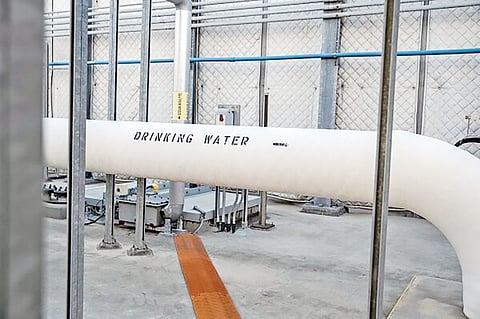

CHENNAI: A recent study has found that disc filter technology is more efficient and cost-effective than conventional rapid sand filters for treating drinking water.
Published in the international journal Water, Air & Soil Pollution, the research compared the performance of rapid sand filters (RSF) and cloth-based disc filters (DF) using water with turbidity levels of up to 20 NTU.
Researchers evaluated key parameters including turbidity removal, total suspended solids (TSS) filtration rate, and operational feasibility. The results showed that disc filters deliver significantly better purification.
Turbidity removal was 47% higher than in rapid sand filters, while TSS removal — indicating better elimination of fine particles and impurities — was 25% higher. Both systems recorded similar filtration rates, though disc filters achieved slightly higher rates under certain conditions. The study also noted that while filtration efficiency declines as turbidity increases, disc filters consistently outperformed sand filters across all tested levels.
The material used in disc filters plays a crucial role in performance. Polypropylene cloth-based disc filters proved more effective than other cloth materials. Additionally, rotating disc filters showed improved filtration rates compared to non-rotating systems, suggesting potential for further technical enhancement.
Speaking to DT Next, Prof Kanmani, HoD-Civil Engineering and Water Resources, Anna University, said contamination from industrial waste along with overexploitation of resources was a major challenge. “Disc filtration technology could significantly improve drinking water quality at low cost. Because it can remove suspended particles and turbidity, it requires a small footprint and minimal backwashing time,” she added.
Researchers also examined practical factors such as space and cost. While disc filters required slightly more space in lab conditions — mainly due to the experimental setup — they proved more cost-effective when considering equipment, construction, and maintenance expenses.
Another key advantage is that disc filters can be easily integrated into existing water treatment plants, reducing the need for major infrastructure changes.
The study concludes that disc filter technology offers a promising alternative for modern drinking water treatment, combining improved efficiency, flexibility, and lower long-term costs. The technology is already being used in wastewater treatment plants.