
- Chennai
- Tamil Nadu
- India
- World
- EntertainmentEntertainment
- Business
- Sports
- Lifestyle
- Technology
- Videos
- Explainers
- Editor's Picks

OD (With PTI, ANI inputs)
CHENNAI: ISRO on Monday confirmed that the PSLV-C62 mission encountered an anomaly in the third stage of the rocket, prompting a detailed investigation.
ISRO Director V Narayanan said the Polar Satellite Launch Vehicle has four stages, two powered by solid fuel and two by liquid fuel. “The rocket’s performance was normal up to the third stage; however, an anomaly was observed toward the end of the PS3 stage. A detailed analysis is currently underway,” he said.
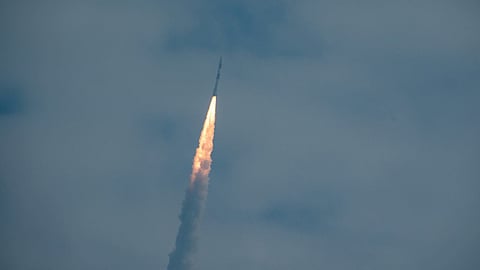
The 44.4-metre PSLV-C62 lifted off from the first launch pad of the Satish Dhawan Space Centre in Sriharikota at 10.18 a.m., carrying an earth observation satellite along with 14 commercial payloads for domestic and international customers.
For the first time, a single Indian private company, Dhruva Space, based in Hyderabad, contributed seven satellites to the mission. Chaitanya Dora Surapureddy, CFO and Co-founder of Dhruva Space, said they also launched four satellites that they built. "We launched four satellites that we have built, three for customers and one for us, and we also help other companies with part of the integration of the satellite onto the rocket.
The mission is part of a contract secured by NewSpace India Ltd, ISRO’s commercial arm and represents the ninth dedicated commercial mission to build and launch an Earth Observation satellite. The rocket was expected to place the satellites into a Sun-synchronous orbit at an altitude of approximately 511 km after a 17-minute flight.
Following satellite separation, scientists had planned to restart the fourth stage (PS4) to de-boost and guide it into a re-entry trajectory for the deployment of the final payload, the Kestrel Initial Technology Demonstrator (KID) capsule. This de-boosting sequence was expected to last over two hours after lift-off. Both the PS4 stage and the KID capsule were scheduled to re-enter the atmosphere and splash down in the South Pacific Ocean, ISRO had stated.
Also, for the first time, a single Indian private company, Dhruva Space, based in Hyderabad, contributed seven satellites to the mission. The satellites are for low-data-rate communication, which amateur radio operators can utilise.