
- Chennai
- Tamil Nadu
- India
- World
- EntertainmentEntertainment
- Business
- Sports
- Lifestyle
- Technology
- Videos
- Explainers
- Editor's Picks
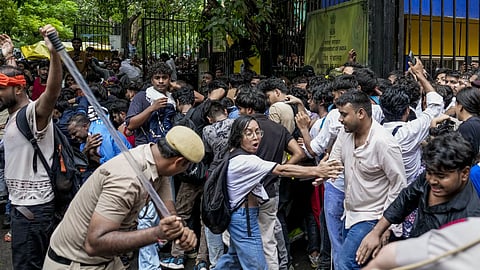
NEW DELHI: One of the petitioners in the NEET protest violence case has urged the Supreme Court to fix the accountability of security personnel who allegedly dragged and used force against peaceful women protesters at Jantar Mantar here on July 20.
The Cockroach Janta Party (CJP)-led march to Parliament in Delhi on July 20 had seen clashes between protesters and security personnel, who used lathis and teargas shells to disperse crowds attempting to move towards Parliament.
The agitation, which began at Jantar Mantar on June 20, was called off on July 25 after the then Union education minister Dharmendra Pradhan resigned and the government accepted the CJP's other demands.
The top court has formed a five-member high-powered committee headed by former top court judge Justice R Subhash Reddy to examine allegations of police excesses against student protesters in Delhi recently and violence against police personnel.
Recently, it quashed all FIRs registered against students who participated in the CJP-led protests across the country between July 20 and July 25, prompting the group to call off its September 5 march in the national capital.
The Delhi Police, in its affidavit, had strongly defended the use of force during the "Chalo Sansad" protest here on July 20, telling the top court that the agitation was hijacked by "anti-social elements" and "history-sheeters", resulting in a breakdown of law and order that left more than 240 police personnel injured.
Shailendra Mani Tripathi, one of the petitioners, filed the rejoinder affidavit before a bench headed by Chief Justice Surya Kant and assailed various contentions of the Delhi Police.
"The specific and undenied instances of male police personnel dragging, physically restraining and using force against women demonstrators, including the dragging of Mrs. Gitanjali Angmo by her hair and the slapping of a woman protester by an Additional DCP…. accountability must accordingly be fixed at the level of the senior-most officers who ordered or permitted the use of such force…," the affidavit said.
It also referred to public admissions allegedly made by Swatantra Bhardwaj about assaulting the father of a teenage student activist and said this showed that persons with violent tendencies were allowed to enter the protest.
"The police deliberately infiltrated chaotic elements into the peaceful procession individuals such as Swatantra Bhardwaj and others, armed with sticks and clubs, with the intent to incite violence to engineer unrest," it said.
"This was done to fabricate a pretext for deploying forceful measures such as lathi charges, pellet guns, tear gas and water cannons, with the sole objective of crushing the peaceful demonstration against the government's flawed education policies," it added.
The petitioner claimed the July 20 march was intended to peacefully protest government policies but was halted by the police through the introduction of "chaotic" elements, followed by the use of disproportionate force.
The affidavit alleged that the sequence of events demonstrated that the law and order situation was "engineered" rather than being an unavoidable consequence of the protest.
Bhardwaj was detained in Bulandshahr on September 4, hours after the CJP protested outside the Parliament Street police station demanding his arrest over the alleged assault.
The Delhi Police has added provisions of the SC/ST (Prevention of Atrocities) Act and criminal intimidation to the FIR against Bhardwaj over the alleged assault on Sanjay Kumar, the father of a teenage student activist, during a CJP-led protest at Jantar Mantar in June. A POCSO case has also been registered against him.
It also highlighted the deployment of Central Armed Police Forces (CAPFs), including the Central Reserve Police Force (CRPF) and the Rapid Action Force (RAF), at Jantar Mantar and along the route to Parliament on July 20. It submitted that the RAF, a specialised wing of the CRPF, operates under the direct operational command of the Union Ministry of Home Affairs (MHA).
"The deployment of central forces under the direct operational command of the Union Home Ministry, in addition to the Delhi Police which is itself administratively superintended by the Union Home Ministry, brings the entirety of the security apparatus deployed on 20.07.2026 within the direct and exclusive constitutional responsibility of the Union of India, acting through the Ministry of Home Affairs," it said.
The petitioner has sought guidelines fixing responsibility on officers ordering or supervising force, preserving records of escalation and requiring consideration of less restrictive alternatives. It also proposed special safeguards for women, students, elderly persons and other vulnerable protesters.
It further sought periodic review of prohibitory orders under Section 163 BNSS, judicially reviewable records supporting restrictions, independent examination of excessive-force allegations and police training in de-escalation, negotiation, peaceful assembly facilitation and constitutional standards governing use of force.
