
- Chennai
- Tamil Nadu
- India
- World
- EntertainmentEntertainment
- Business
- Sports
- Lifestyle
- Technology
- Videos
- Explainers
- Editor's Picks
KOLKATA: In West Bengal's election season, Bhabanipur is preparing for two processions, two rival political theatres and perhaps the most symbolic duel of the 2026 assembly polls.
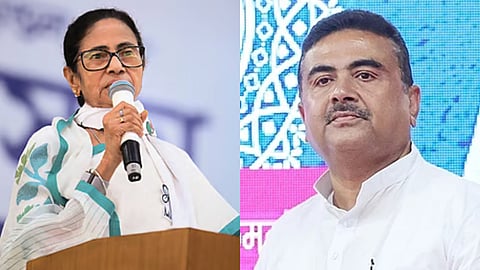
On April 2, Leader of the Opposition Suvendu Adhikari is expected to file his nomination papers from the south Kolkata constituency, accompanied by Union Home Minister Amit Shah and an array of senior BJP leaders in what the party hopes will be a show of strength.
Six days later, on April 8, Chief Minister Mamata Banerjee is likely to set out from her Kalighat residence and walk in a procession to the Gopalnagar Survey Building to submit her documents, surrounded by the TMC leadership that has stood by her through three decades of political battles.
The two marches, separated by less than a week, are set to frame Bhabanipur not merely as another assembly constituency but as the state's principal political battlefield, where West Bengal's two most formidable rivals will once again face one another.
For Banerjee, Bhabanipur is more than a constituency; it is political home turf. It was from here that she returned to the assembly in 2011 after becoming the chief minister, and it was here again that she staged her comeback through a by-election in 2021 after losing the high-voltage Nandigram contest to Adhikari.
This time, however, the battle has followed her home. The BJP has fielded Adhikari against Banerjee in Bhabanipur, turning the constituency into a sequel to the bitter 2021 Nandigram contest.
In Nandigram, Banerjee had gone to Adhikari's backyard and lost. In 2026, it is Adhikari who is entering her bastion.
According to TMC sources, Banerjee's April 8 procession is likely to begin from her residence in Kalighat and proceed to the nomination centre at the Gopalnagar Survey Building.
The march may include state party president Subrata Bakshi, Kolkata Mayor and Urban Development Minister Firhad Hakim, South Kolkata district president Debasish Kumar and nearly all TMC councillors from Bhabanipur and adjoining wards.
The message the party wants to send is unmistakable: that despite anti-incumbency, erosion in urban support and the BJP's aggressive campaign, Bhabanipur remains emotionally and organisationally tethered to Banerjee.
The BJP, however, is preparing an equally symbolic counter-narrative.
Adhikari's nomination on April 2 is expected to be preceded by a roadshow with Shah at its centre, giving the contest national visibility and underlining the BJP's attempt to project Bhabanipur as the seat where Banerjee can be defeated in her own backyard.
Party leaders said Shah's presence is meant to energise workers and consolidate anti-TMC votes in south Kolkata, where the BJP has traditionally struggled to convert support into seats.
The optics are important because Bhabanipur is no ordinary constituency. With its mix of upper middle-class Bengali households, Hindi-speaking traders, minorities, Congress-supporting families and pockets of urban poor, the seat often reflects the social chemistry of Kolkata.
The TMC has long relied on a coalition of women, minorities and local organisational networks in the seat. The BJP, however, believes the arithmetic has changed. That belief has been strengthened by the special intensive revision of the electoral rolls.
According to political estimates, nearly 47,000 names in Bhabanipur have been deleted from the voter list, while another 14,000 remain under adjudication.
The figure is significant because it is only around 11,000 less than the 58,000-vote margin by which Banerjee had won the Bhabanipur bypoll in 2021.
More significantly for the TMC, over 56 per cent of those whose names are under scrutiny are believed to be Muslims, even though the community accounts for around 24 per cent of the constituency's electorate.
The TMC has alleged that the revision exercise could disproportionately affect its support base, while the BJP has maintained that the process is aimed only at removing duplicate and ineligible voters.
The constituency has therefore become the X factor in West Bengal's electoral calculus.
For the TMC, Bhabanipur is not merely another seat on the electoral map; it is the political address from which Mamata Banerjee has ruled West Bengal for a decade and a half.
For the BJP, the constituency offers something larger than one assembly seat. It is the chance to demonstrate that the saffron party can finally breach south Kolkata, puncture Banerjee's aura of invincibility and turn the election into a direct contest centred around her.
That is why both parties are investing the nomination process itself with unusual political meaning. Banerjee's march from Kalighat is meant to project familiarity, emotion and ownership. Adhikari's procession with Shah is designed to convey momentum, aggression and the sense that the BJP is now knocking at the gates of the TMC citadel.
Between those two processions perhaps lies the most consequential battle of the 2026 West Bengal polls.
