
- Chennai
- Election-2026Election-2026
- Tamil Nadu
- National
- World
- Cinema
- Business
- Sports
- Lifestyle
- Technology
- Videos
- Explainers
CHENNAI: India added startups at a pace it hadn't seen before over the past decade. But it's not just how many were created, but where they came from, how they were funded, and how few of them are likely to grow into large businesses.
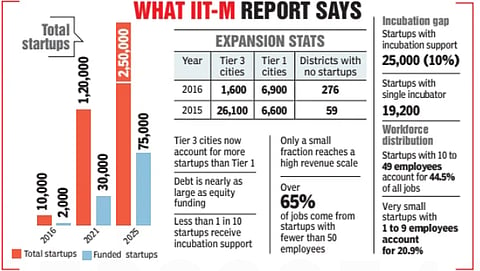
A report by the Centre for Research on Start-ups and Risk Financing (CREST) at IIT Madras shows that startup incorporations rose from about 10,000 in 2016 to 1,20,000 in 2021 and further to 2,50,000 by 2025. Funded ventures rose faster from 2,000 in 2016 to 30,000 in 2021 and 75,000 in 2025.
The peculiar part of this report is that this expansion has not stayed within the conventional startup hubs. Tier 1 cities accounted for about 6,900 startups in 2016 and 12,600 in 2020, but their numbers fell to around 6,600 by 2025. In contrast, Tier 3 cities grew from about 1,600 startups in 2016 to around 7,000 in 2020 and further to about 26,100 by 2025, overtaking Tier 1 cities. At the district level, the number of districts with no registered startups declined steadily from 276 in 2016 to 110 in 2020 and to 59 by 2025.
However, the expansion in numbers has not been matched evenly by capital. While 2,50,000 startups exist in the system, only about 75,000 have received funding. Funding is also concentrated in fewer sectors, with e-commerce, fintech, mobile apps, SaaS, and AI accounting for a large share of investment, while sectors such as construction and food, despite high startup counts, see lower funding participation.
The funding structure has also changed. The combined angel and venture capital funding grew nearly tenfold over the decade, with venture capital funding supporting a larger number of startups compared to angel investors. Also, alongside equity, debt has become a significant source of capital. Debt funding contributed about Rs 14.06 trillion over the decade, compared to Rs 20.34 trillion from equity and grants.
Deep technology startups have seen a sharp increase in funding, rising from about Rs 163 billion in 2016 to roughly Rs 2.5 trillion in 2025, with a peak of around Rs 3.3 trillion in 2022.
The composition of founders has also shifted. Around 66% of male founders and 59% of female founders are under 40. The number of women founders increased from about 5,800 in 2017 to 14,200 in 2021 and further to 18,700 by 2025. Among younger founders under 30, women account for about 24%, compared to 35% for men.
Even as the ecosystem expanded, support systems have lagged. Of roughly 3 lakh startups, only about 25,000 have received formal incubation support. About 19,200 startups are supported by only one incubator, with very limited multi-incubator engagement. At the same time, about 840 incubators fall into a "weak ecosystem" category, with low conversion of supported startups into funded ventures.
This imbalance is reflected in outcomes. Of a sample of 4,500 startups, only about 162, around 3.6%, have reached revenue levels above Rs 10.1 billion. Employment is also distributed unevenly. Startups with 10–49 employees account for about 44.5% of jobs, while micro-startups with 1–9 employees account for another 20.9%. Large startups contribute a much smaller share of total employment.