
- Chennai
- Tamil Nadu
- India
- World
- EntertainmentEntertainment
- Business
- Sports
- Lifestyle
- Technology
- Videos
- Explainers
- Editor's Picks

CHENNAI: India will remain firm on issues of sovereignty and security while continuing to act as a responsible global stakeholder, External Affairs Minister S Jaishankar said on Friday, asserting that coercive tactics by adversaries and geopolitical pressures would not alter India’s core positions.
Leading with India’s external challenges, Jaishankar said recent actions by China, including the detention and harassment of an Indian citizen from Arunachal Pradesh during transit, had been formally protested. “Such incidents change nothing on the ground. Arunachal Pradesh is, and will always remain, an integral part of India,” he said, underlining that India’s stance on territorial integrity was clear, firm and unwavering.
Drawing a sharp contrast, Jaishankar said India had been compelled to take hard decisions with Pakistan, a neighbour that has repeatedly supported terrorism. “After decades of violence, no one can lecture India on how to defend itself. Cutting engagement in such circumstances is a legitimate sovereign choice,” he said, adding that normal neighbourhood relations were impossible amid sustained cross-border terror.
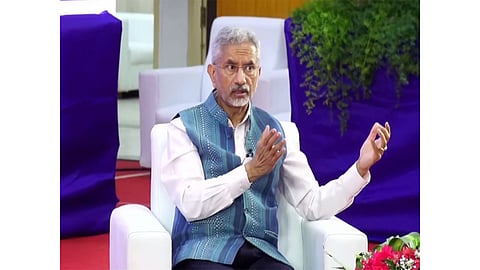
Interacting with the students after launching the IIT Madras Global Research Foundation, The Athena Constellation (TAC), Jaishankar broadened the discussion to India’s global outlook, describing the country as a civilisation-state that had successfully transitioned into a modern technology-driven nation. India’s approach, he said, was ‘non-West, not anti-West’, shaped by confidence in its own history, culture and values.
He noted that two centuries of Western colonial dominance had suppressed the cultural diversity of many societies, a phase the world is now emerging from. “This return of diversity is not a threat. It can co-exist with the West and, in many ways, reinforce shared democratic beliefs,” he said, stressing the importance of constructive partnerships with Western nations.
On regional diplomacy, Jaishankar reaffirmed India’s commitment to Bangladesh, saying New Delhi consistently sought to be a supportive and dependable neighbour. He said he had recently visited Dhaka to attend the funeral of former Prime Minister Khaleda Zia and expressed hope that stability would prevail as Bangladesh heads towards elections. “When India grows, its neighbours grow,” he said.
Referring to the Ukraine war, Jaishankar said global crises had exposed the fragility of supply chains and the risks of over-dependence. During shortages of food, fuel and finance triggered by the conflict, India shared what it had, he said, reinforcing its belief that wars cannot be prolonged indefinitely in an interconnected world. “Those who control supply chains will inevitably use them. That reality demands constant risk assessment and mitigation,” he observed.
Highlighting India’s pandemic response, Jaishankar said vaccine diplomacy had created an unparalleled emotional impact worldwide. While some wealthy Western nations hoarded vaccines, India, even while vaccinating its 1.4 billion people, supplied doses to neighbours and countries across Africa, Latin America and Asia, he said.
On Afghanistan, Jaishankar said India’s engagement was guided by centuries-old societal ties and a people-centric approach, with continued assistance in food, vaccines, agriculture and development despite the country’s turmoil.
Earlier, IIT-M Director V Kamakoti said IITM Global would take Indian technology, startups and academic collaborations overseas, citing the IIT-M Zanzibar campus as a strategic intervention in Africa’s transformation. Jaishankar also inaugurated the Shaastra 2026 festival fortnight.