
- Chennai
- Tamil Nadu
- India
- World
- EntertainmentEntertainment
- Business
- Sports
- Lifestyle
- Technology
- Videos
- Explainers
- Editor's Picks

At this stage, how do you define Agnikul?
We were very clear from the beginning that we wanted to be a space transportation company. If someone wants to go to space, Agnikul should be the first name that comes to mind. It should be the most value-adding service. Everything we build, whether it's technology or operations, is designed to make access to space faster, cheaper, and more reliable.
Is building the engine the most challenging part or building the system around it?
Initially, it was about building the engine. Everything is one-off. The question now is how to take it from 1 to 10 or 1 to 100. Currently, the challenge is scaling and making multiple engines with the same reliability. The thresholds are very high. That's where the supply chain becomes important. As a founder, my role is to focus on what is not there. If something exists, the team will handle it. My job is to identify gaps and fix them.
Is that where the move to larger 3D-printed engines comes in?
Yes, it came out of necessity. You can't use the same technology as large rockets for smaller rockets; it won't be inexpensive. So, we had to adopt a new manufacturing technique, and that's why we went with 3D printing.
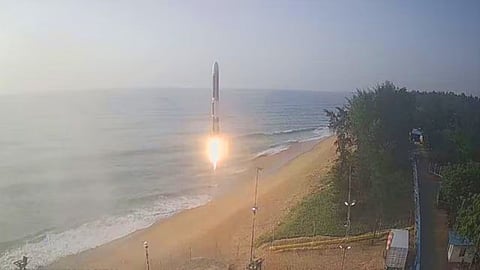
We first built a smaller engine and flew it in 2024. That gave us confidence that this approach works. After that, for a commercial rocket, we needed a bigger engine. We took the largest printer available and pushed it to the limit.
On Tamil Nadu government investment…
It was like a proper venture capitalist process. There was financial, legal and technical due diligence. They brought in external experts, visited us, and we had to pitch. There was no difference in the process except that it was a government-backed entity. It gives us credibility. Tamil Nadu is generally seen as a more risk-averse state. So when such a government invests, it signals strong potential. That validation matters.
The Centre has democratised the space business. Now, TN also has multiple policies. Are they on the same pace as innovation?
We can always do more. Policy is like that, you can keep refining it. But if you look at Tamil Nadu, there is already a lot in place. There is a startup policy, a deep-tech policy, and a space policy. From our standpoint, the framework exists. The issue is not absence, but access. You have to go through StartupTN, then Guidance Tamil Nadu, and then find the schemes. It's not available in one place. In other places, even if systems are similar, they are communicated more. We have everything here (Tamil Nadu), but we don't talk about it enough.
How does the idea of data centres in space pan out?
We had put this idea out in 2019. On Earth, a large part of the operational cost of a data centre is cooling. That's why they are placed in colder regions or even underwater. In space, heat can be radiated away because of the environment. So, you wouldn't need the same level of active cooling. We've signed an MoU with a data centre company that wants to use our rocket to deploy a data centre in space. If fruitful, this would be among the first. We are planning to launch a prototype soon.
What defines a successful year for you?
We are a space transportation company. A launch contract is a ticket to space. From a business perspective, customers should be happy. Beyond that, the team should feel they've done meaningful work. As a founder, I should be creating opportunities and returning value to shareholders.
What's next for Agnikul?
Commercial launches are next. We are also working on recovery operations, bringing parts of the rocket back and landing them. And we will be expanding access to multiple launch sites, including Kulasekarapattinam.